APR vs APY: Why the Same Rate Can Mean Different Money
You check the fine print on a savings account and it says 5%. At the end of the year, you do the math and the effective return comes out to 5.12%. So which number lied? Neither, actually. The account had two different rates listed under two different names — and the distinction between them is worth understanding before you sign anything.
APR and APY are not interchangeable. Confuse them, and you end up underestimating what a loan actually costs, or overestimating what a savings product really returns. Let’s break it down with the formula and real numbers.
What APR Actually Measures
APR — Annual Percentage Rate — is the nominal annual rate. It converts a periodic interest rate into a yearly figure through simple multiplication, with no compounding factored in.
Take an APR of 12% on a loan that compounds monthly. The monthly rate is 12% ÷ 12 = 1%. That 1% hits each month, but the APR figure itself does not account for the fact that last month’s interest is now part of the balance earning more interest. It strips out compounding to give you a clean, comparable-looking number.
You’ll see APR most often on loans, credit cards, and mortgages. One important caveat: in some contexts, APR includes fees (origination charges, closing costs) on top of the interest rate. Whether fees are folded in or not depends on the product and the jurisdiction. If you want to see how even a 1% annual fee compounds against you over decades, Why a 1% Fee Quietly Costs You Half Your Retirement breaks that down in detail. This article focuses on the core mathematical distinction — nominal vs. effective rate — rather than fee accounting, since that varies too much to generalize.
What APY Actually Measures — The Compounding Reality
APY — Annual Percentage Yield — is the effective annual rate (EAR). It answers a simple question: given compounding, what is the true annual return or cost?
When compounding occurs once per year, APR = APY. That’s not a coincidence — it’s literally what the math works out to. As compounding frequency increases (quarterly, monthly, daily), APY climbs above APR because interest is being earned on interest more often. Savings account ads love APY for exactly this reason: it’s the bigger number. For a deeper look at why compounding behaves the way it does — slow at first, then explosive — see Why Compound Interest Takes Decades to Pay Off.
The Formula and the Numbers
The relationship is straightforward:
APY = (1 + APR / n)ⁿ − 1
Here, n is the number of compounding periods per year. The theoretical upper bound — continuous compounding — is e^r − 1, but daily compounding (n = 365) gets you close enough for any practical purpose.
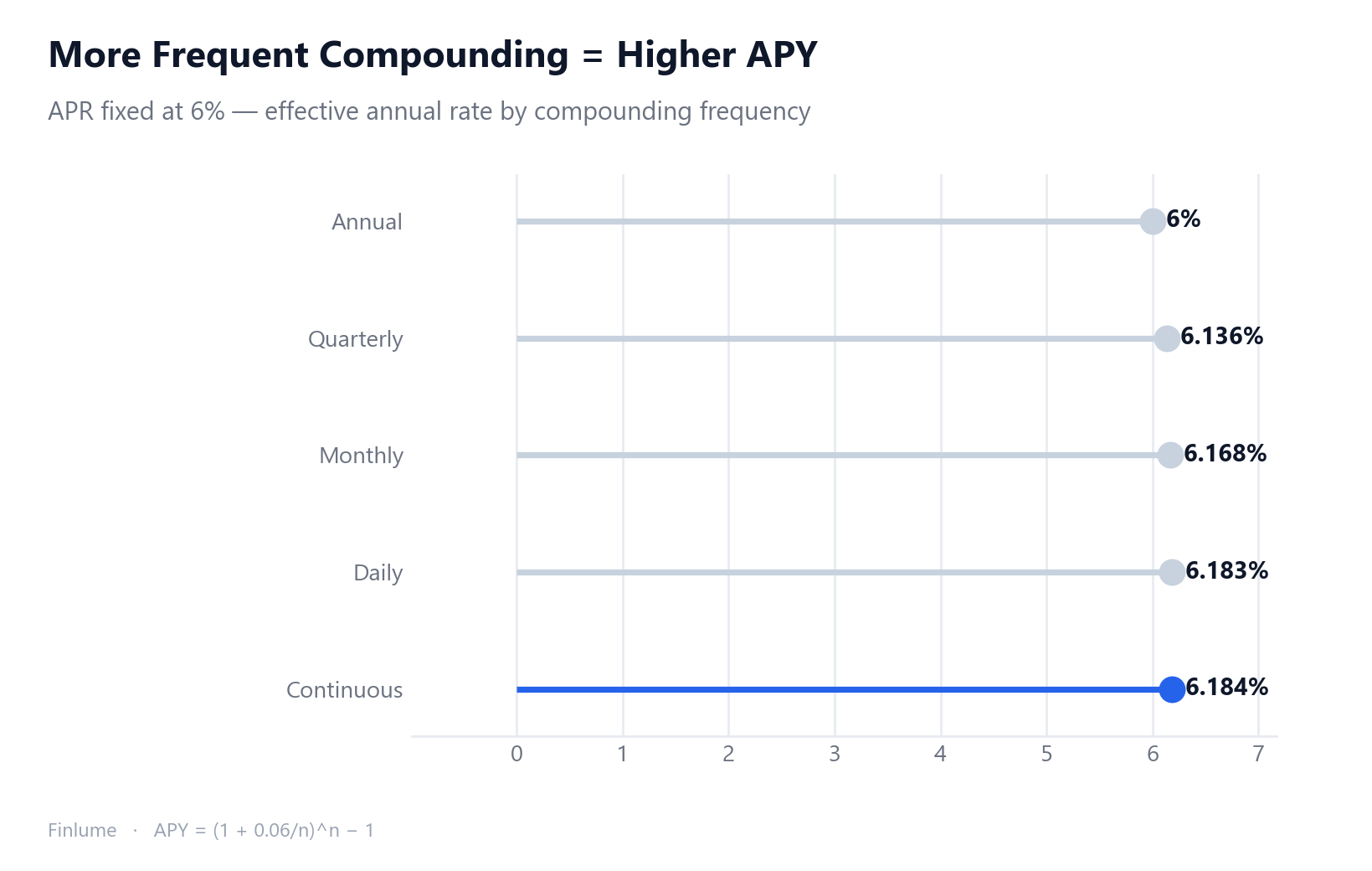
Here’s what APR 6% looks like across compounding frequencies:
| Compounding | n | APY |
|---|---|---|
| Annual | 1 | 6.000% |
| Quarterly | 4 | 6.136% |
| Monthly | 12 | 6.168% |
| Daily | 365 | 6.183% |
| Continuous (theoretical limit) | ∞ | 6.184% |
At APR 10%, daily compounding gives an APY of roughly 10.516%.
I’ve seen people spend a lot of energy hunting for daily-compounding accounts versus monthly-compounding ones. The table shows why that’s probably misdirected effort — the gap between monthly and daily is about 0.015 percentage points. The APR itself matters far more. Negotiate the rate; don’t obsess over the compounding schedule. The underlying mechanics of why this is so are rooted in the time value of money — a concept worth understanding alongside APR and APY.
The APR/APY Asymmetry in Practice
This is where things get interesting. Lenders advertise APR. Savings products advertise APY. That pattern is not an accident.
- For lenders, APR is the smaller number. A loan at APR 6% sounds cheaper than the same loan quoted as APY 6.17%.
- For savings products, APY is the larger number. A savings account yielding APY 5.12% sounds better than the same account quoted at APR 5.00%.
The result: as a borrower, you see the cost understated; as a saver, you see the return overstated relative to the other side’s metric. Neither number is dishonest on its own — they just measure different things. The problem is comparison shopping across products that use different conventions. And once you have the real yield in hand, remember that inflation quietly erodes savings — even a solid APY can lose ground to rising prices.
Practical fix: whenever you compare two products, convert both to APY. The formula does the work in ten seconds.
Common Misconceptions Worth Clearing Up
“Lower APR always means a cheaper loan.” Not if the compounding frequencies differ. Two loans at APR 6% can have different true costs depending on whether compounding is monthly versus quarterly. Check the APY.
“APR always includes fees.” Sometimes, sometimes not. Some institutions roll origination or closing fees into APR; others quote a pure interest-rate APR. The only way to know is to read the disclosure document.
“APY is always bigger than APR.” Only when n > 1. If a product compounds once per year, APR = APY exactly. APY is never smaller than APR, but it is not always strictly larger.
“Continuous compounding is a real product feature.” It is a mathematical limit, not a common product structure. It tells you the ceiling — nothing actually beats it, but daily compounding is already within 0.001 percentage points of that ceiling at typical rates.
How Much Does the Gap Actually Matter? A Cross-Rate Lookup
The formula is clear, but one number (APR 6%) doesn’t capture how the APR→APY gap scales with the rate itself. The higher the APR, the more compounding amplifies the spread — and the more it costs you to confuse the two.
The table below shows APY for five realistic APR levels under quarterly and monthly compounding (the two schedules you’ll most commonly encounter). All figures computed from APY = (1 + APR/n)ⁿ − 1; no estimates.
| APR | APY — Quarterly (n=4) | APY — Monthly (n=12) | Gap vs. APR (monthly, basis pts) |
|---|---|---|---|
| 3% | 3.034% | 3.042% | +4 bp |
| 5% | 5.095% | 5.116% | +12 bp |
| 7% | 7.186% | 7.229% | +23 bp |
| 10% | 10.381% | 10.471% | +47 bp |
| 15% | 15.865% | 16.075% | +108 bp |
What this shows: At a 3% mortgage rate (monthly compounding), the APR understates your true cost by just 4 basis points — barely worth worrying about. At 15% APR (common for personal loans and credit cards), the gap jumps to 107.5 basis points, or just over 1 full percentage point. That is a 25× larger distortion for the same nominal gap in APR. In other words, the APR/APY confusion is mostly harmless on a low-rate mortgage but genuinely misleading on high-rate consumer credit — exactly where borrowers can least afford to underestimate the cost.
Two practical takeaways from this table: first, if you are comparing a low-rate product (mortgage, car loan), the compounding schedule barely moves the needle — focus on the rate itself. Second, if the advertised APR is in double digits, always convert to APY before signing; the difference is large enough to change your decision.
Key Takeaways
- APR = nominal annual rate, no compounding adjustment
- APY = effective annual rate, compounding included. Always APR ≤ APY (for n ≥ 1)
- Formula: APY = (1 + APR/n)ⁿ − 1
- APR 6%, monthly compounding → APY ≈ 6.17% / APR 10%, daily compounding → APY ≈ 10.52%
- Lenders show APR (smaller), savings products show APY (larger) — know the asymmetry
- Compare apples to apples: always use the same basis (both APR or both APY)
- The APR→APY gap scales with the rate: +4 bp at 3%, +108 bp at 15% — the confusion is most costly on high-rate debt
One habit that pays off: before signing any financial product, identify whether the advertised rate is APR or APY. Ten seconds with the formula can save you from a surprise at year-end.
Frequently Asked Questions
Q. What is the difference between APR and APY?
APR is the nominal annual rate with no compounding baked in. APY reflects actual compounding and shows what you earn or pay in a year. When compounding happens once a year, APR equals APY. More frequent compounding always pushes APY above APR.
Q. How do you calculate APY from APR?
APY = (1 + APR/n)^n − 1, where n is the number of compounding periods per year. For APR 6% compounded monthly (n=12): APY = (1 + 0.06/12)^12 − 1 ≈ 6.17%.
Q. Why do loans show APR and savings accounts show APY?
It is a marketing asymmetry. Lenders prefer the smaller-looking APR; savings products prefer the larger-looking APY. To compare fairly, always convert both to the same basis.
Q. If a loan says APR 6% and a savings account says APY 6%, are they the same?
No. APR 6% compounded monthly works out to APY 6.17% — so you pay more than 6% in real terms. An APY of 6% already reflects compounding and means exactly 6% earned. They are not equivalent.