Why a Dollar Today Is Worth More Than a Dollar Tomorrow
Here’s the bottom line up front: $10,000 in your hand today and a promise of $10,000 a year from now are not the same thing — even if inflation were zero. This isn’t a trick of accounting. It’s one of the most fundamental principles in all of finance. Once you really internalize it, the way you look at loan terms, payment schedules, and investment timing shifts entirely. I’ve watched people make costly decisions simply because they compared nominal totals rather than present values.
What the Time Value of Money Actually Means
The time value of money (TVM) states that money available today is worth more than an identical amount in the future. It’s not an assumption — it’s a consequence of how money works in a world where you can do something productive with it right now.
Three forces drive this:
- Opportunity cost: Money you receive today can be invested immediately. If you have to wait a year, that year of potential returns is gone forever. This is why every financial decision carries a hidden price tag — the value of the best alternative you didn’t take.
- Risk: The future is uncertain. A payment promised a year from now carries the risk that it won’t arrive — or won’t arrive in full. Certainty today has real value.
- Liquidity preference: People naturally prefer having money accessible now rather than later. The ability to respond to unexpected needs is worth something.
On top of these three, inflation steadily erodes purchasing power. If prices rise 3% a year, $10,000 received in twelve months only buys what roughly $9,709 buys today. The nominal amount stays the same; the real value shrinks. How quietly inflation eats away at savings is worth understanding in concrete numbers — the effect is larger than most people expect.
The Present Value and Future Value Formulas
The math is straightforward once you see the two sides:
Future Value (FV): What does money invested today grow into?
FV = PV × (1 + r)^nPresent Value (PV): What is a future payment worth in today’s dollars?
PV = FV ÷ (1 + r)^nPV= Present ValueFV= Future Valuer= discount rate or expected return (as a decimal: 5% → 0.05)n= number of periods (years)
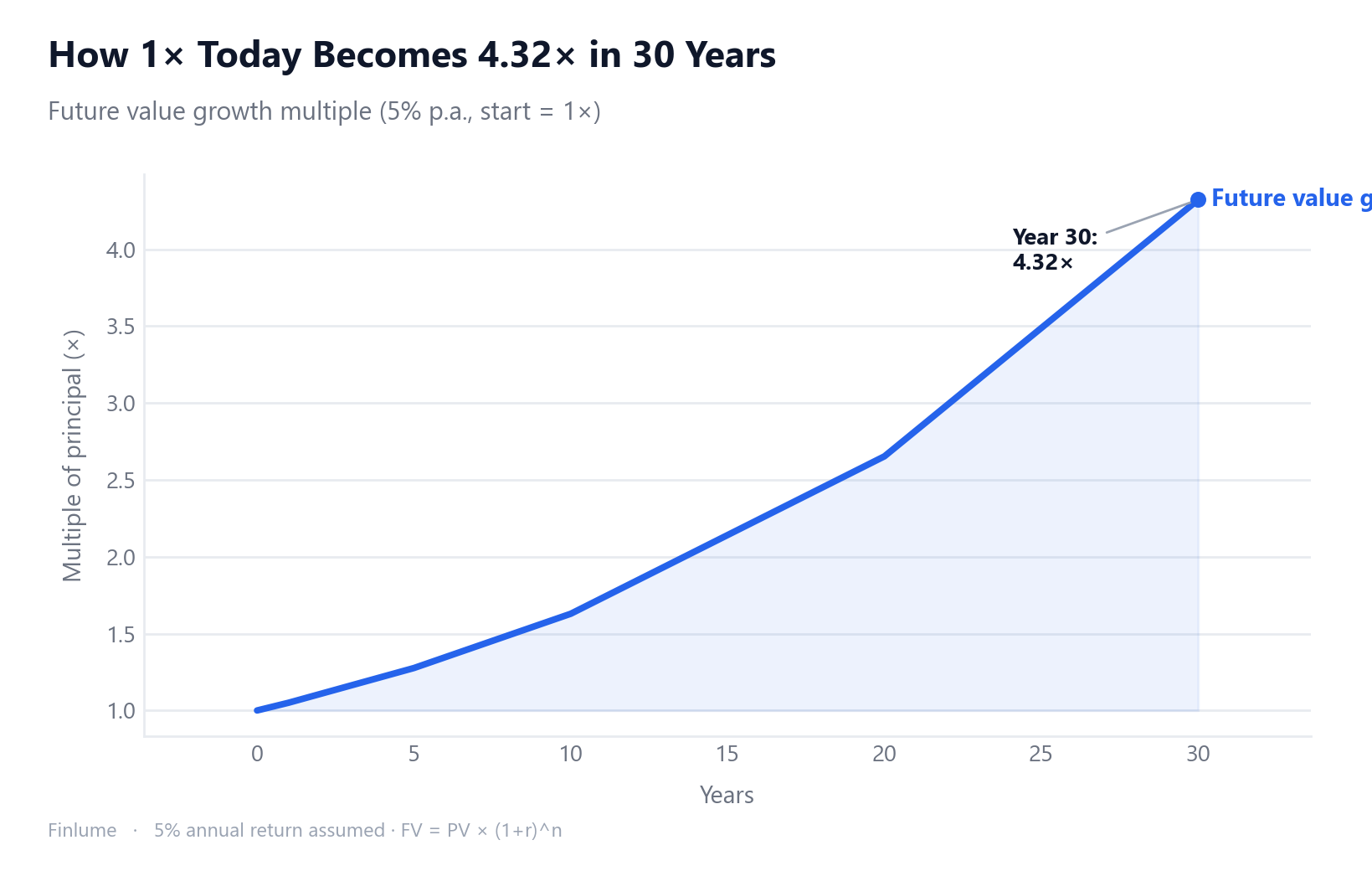
Let’s put numbers to it. Invest $10,000 today at 5% annually:
| Years | Future Value (r = 5%) | Multiple of principal |
|---|---|---|
| 1 | ~$10,500 | 1.05× |
| 5 | ~$12,763 | 1.28× |
| 10 | ~$16,289 | 1.63× |
| 20 | ~$26,533 | 2.65× |
| 30 | ~$43,219 | 4.32× |
Now flip it: if someone offers you $16,289 in ten years, and your discount rate is 5%, that offer is worth exactly $10,000 today. Future value and present value are two faces of the same coin.
The r in the denominator is called the discount rate — the rate at which you’re converting a future sum back into today’s terms. A higher discount rate shrinks the present value of any future payment. This is why high-inflation environments or high interest rate environments make future promises worth less.
The Rule of 72 as a Quick Sanity Check
Before you reach for a calculator, there’s a mental shortcut worth keeping in your back pocket:
72 ÷ annual return rate (%) ≈ years to double your money
At 6%, that’s 12 years. At 8%, it’s 9 years. At 9%, roughly 8 years.
| Return rate | Rule of 72 estimate | Exact calculation |
|---|---|---|
| 6% | 12.0 years | 11.9 years |
| 7% | 10.3 years | 10.2 years |
| 8% | 9.0 years | 9.0 years |
| 10% | 7.2 years | 7.3 years |
The rule works best in the 6–10% range, but the real insight is applying it in reverse. If a credit card charges 18% annually, 72 ÷ 18 = 4 years until your balance doubles — if you’re not paying it down. The same compounding logic that grows investments over time works just as relentlessly against you when you’re the one paying interest.
Lump Sum vs. Installments: The Practical Test
The most direct real-world application of TVM is comparing a lump sum offer against a series of payments.
Imagine you’re offered two options:
- Option A: $10,000 today
- Option B: $3,800 per year for three years (total: $11,400)
Option B has a higher headline number. But at a discount rate of 8%, here’s what each payment in Option B is actually worth right now:
| When received | Payment | Present value (r = 8%) |
|---|---|---|
| Year 1 | $3,800 | ~$3,519 |
| Year 2 | $3,800 | ~$3,258 |
| Year 3 | $3,800 | ~$3,017 |
| Total | $11,400 | ~$9,794 |
The present value of Option B ($9,794) is actually less than Option A ($10,000). Despite paying out $1,400 more in nominal terms, the installment plan is the worse deal at this discount rate.
If the discount rate drops to 5%, Option B’s present value rises to about $10,344 — now the installment plan wins. The crossover point is entirely determined by the discount rate, which in practice reflects your expected investment returns or the prevailing inflation rate.
I’ve seen people choose the higher nominal total without ever running this comparison, then wonder why it didn’t feel as good as they expected. The math doesn’t lie — you just have to do it.
The Link to Compound Interest
TVM and compound interest are the same principle in different clothes.
- The FV formula
FV = PV × (1+r)^nis the compound interest formula. - TVM explains why investing today beats waiting — the opportunity cost argument.
- Compound interest shows what happens mechanically as money grows over time.
Inflation is also a form of time value working against you. If your investments only return 3% nominally but inflation runs at 3%, your real return is zero — the purchasing power of your money hasn’t actually grown. This is why the discount rate you use should, at minimum, reflect the inflation rate. Anything below that and you’re accepting a guaranteed real loss. One practical way to put TVM to work is dollar-cost averaging — investing a fixed amount on a regular schedule so compounding and time value accumulate automatically over decades.
The Real Cost of Waiting: A Multi-Scenario Lookup Table
The lump-sum vs. installments example is useful, but it only shows one snapshot. The deeper question is: how much does delay itself cost you, across different realistic discount rates?
The table below answers that directly. Each cell shows what fraction of today’s value is retained if receipt is delayed by N years — computed as 1 ÷ (1 + r)^n. The remainder (100% minus the cell) is the opportunity cost you silently surrender. All figures assume the discount rate equals your expected investment return (assumed inputs: 3%, 5%, 7%, 10% annually).
| Delay | r = 3% | r = 5% | r = 7% | r = 10% |
|---|---|---|---|---|
| 1 year | 97.1% | 95.2% | 93.5% | 90.9% |
| 3 years | 91.5% | 86.4% | 81.6% | 75.1% |
| 5 years | 86.3% | 78.4% | 71.3% | 62.1% |
| 10 years | 74.4% | 61.4% | 50.8% | 38.6% |
| 20 years | 55.4% | 37.7% | 25.8% | 14.9% |
Two numbers stand out. At a 7% discount rate — roughly a long-run equity return assumption — waiting just 10 years means you retain only 50.8% of today’s value. Waiting 20 years drops that to 25.8%: three-quarters of the real value is gone. At 10%, a 20-year delay leaves you with a mere 14.9 cents on the dollar.
This is why the timing of a windfall, an inheritance, a pension start date, or a bond maturity matters enormously — often more than the headline amount. A payment that looks large on paper can be a fraction of its apparent value once you discount for time and opportunity cost.
Key Takeaways
- Three drivers: opportunity cost + risk + liquidity preference — all push the value of future money below today’s money.
- Inflation compounds the effect, eroding purchasing power over time.
- FV formula:
FV = PV × (1+r)^n— what today’s money becomes tomorrow. - PV formula:
PV = FV ÷ (1+r)^n— what tomorrow’s money is worth today. - Higher discount rate = smaller present value for any future payment.
- Rule of 72: 72 ÷ return rate (%) ≈ years to double. Works for debt, too.
- Lump sum vs. installments: compare present values, not nominal totals. Higher inflation favors taking the lump sum.
- Cost of waiting: at a 7% discount rate, a 10-year delay destroys nearly half the real value — the table above turns this into a quick lookup across realistic scenarios.
Understanding time value doesn’t require advanced math. It requires one habit: asking “when?” every time you see a dollar figure. The timing changes the value — always.
Frequently Asked Questions
Q. What is the time value of money?
It’s the principle that money available today is worth more than the same amount in the future. The three reasons: opportunity cost (you can invest now), risk (the future is uncertain), and liquidity preference (cash on hand is instantly useful).
Q. What is the present value formula?
PV = FV ÷ (1 + r)^n. You divide the future amount by the discount rate and the number of periods to find what it’s worth today. The higher the discount rate, or the further away the payment, the smaller the present value.
Q. How does the Rule of 72 relate to time value?
Divide 72 by the annual return rate (%) to estimate how many years it takes to double your money. At 8%, that’s 9 years. It’s a quick gut-check for how powerfully investing today beats waiting.
Q. Is a lump sum better than installments?
It depends on the discount rate. You have to convert each installment to its present value and sum them up, then compare to the lump sum. The higher the discount rate (inflation or expected return), the more attractive the lump sum becomes.