How to Choose a Brokerage Account: What Actually Matters
I’ve heard some version of this more times than I can count: “The commission was zero, so I thought I was getting a good deal — then I noticed the 0.8% FX conversion fee and the $15 quarterly inactivity charge buried in the fine print.” The “$0 commission” headline is doing a lot of work to obscure a lot of costs.
Here’s the honest position upfront: I’m not going to tell you which broker is best. That’s not a cop-out — it’s accurate. The right brokerage account depends on how you invest, how much you invest, and where you live. What this guide gives you is a decision framework: seven criteria that let you evaluate any broker on your own terms.
Decoding the Fee Structure: “Free” Is a Starting Point, Not a Conclusion
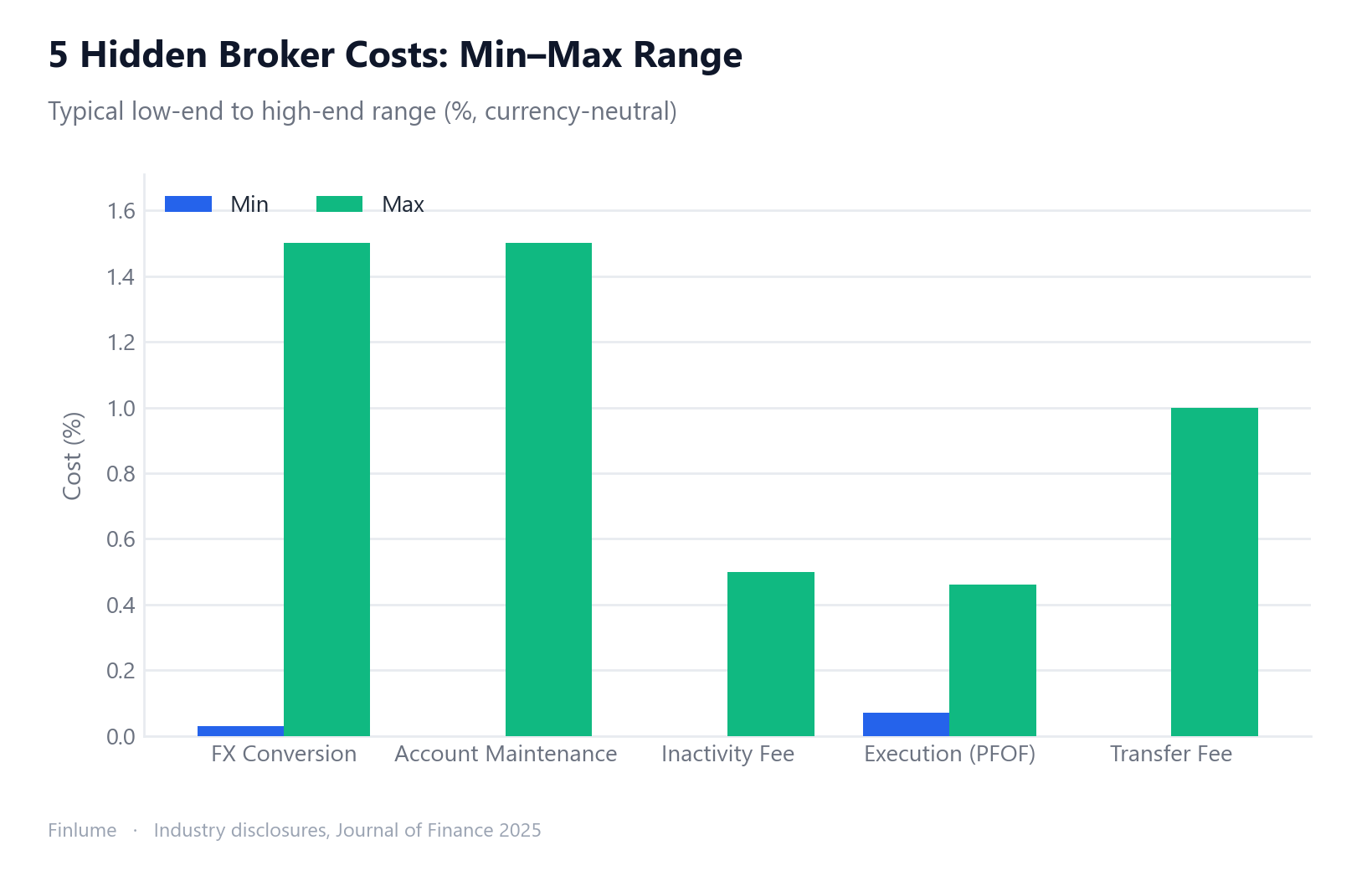
The “$0 commission” era is real, but it shifted revenue streams rather than eliminating costs. Here are the five hidden cost layers to examine before you sign up:
| Cost Item | Typical Range | Why It’s Easy to Miss |
|---|---|---|
| PFOF / spread impact | 0 to ~$15 per 500-share order | Never appears on your statement |
| FX conversion fee | 0.03%–1.5% | Blended into quoted exchange rate |
| Account maintenance fee | $0–$50/year or 0.25%–1.5% of assets | Buried in account terms |
| Inactivity fee | $5–$50/quarter if no trades | Triggered by doing nothing |
| Withdrawal / transfer fee | $0–$150 per event | Hits you when you want to leave |
One confusion worth clearing up: an ETF’s expense ratio (TER) is a fund-level cost, not a broker fee. It accrues inside the fund regardless of which broker you use. Both costs compound against you over time, but they’re controlled separately. For a deeper look at how fund fees chip away at long-run returns, see ETF Expense Ratio Long-Term Impact.
The Real Cost of “Free Trading”: PFOF and Spread Quality
Payment for Order Flow (PFOF) is the practice where a broker routes customer orders to a market maker and receives compensation in return. The market maker profits from the bid-ask spread, which can leave you with a slightly worse execution price than you would have received on a lit exchange. A “$0 commission” trade is not a free trade — it is a trade where the cost has moved off your statement.
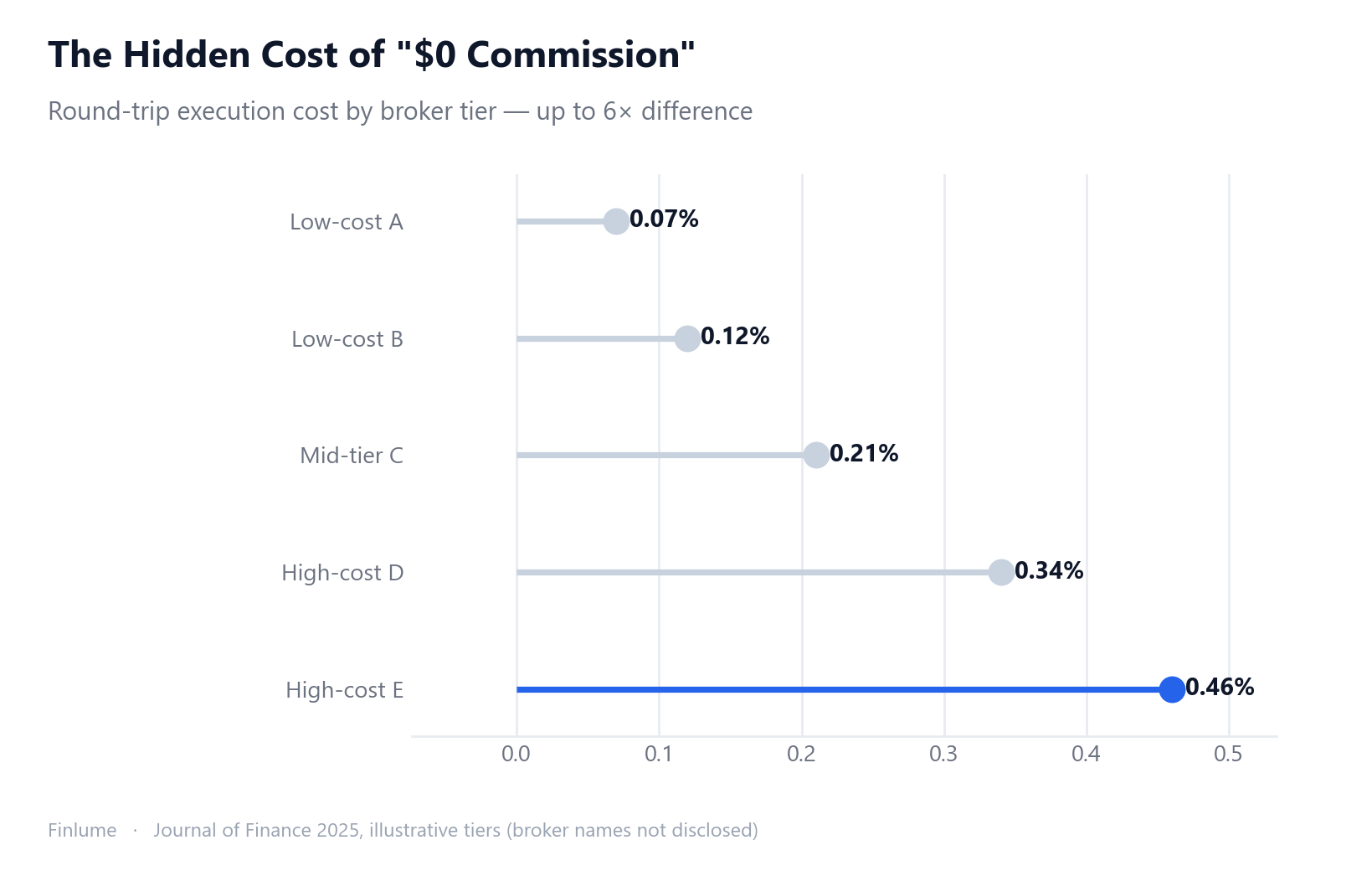
A $0 commission is not a profit-free trade. It’s a different revenue structure.
Payment for Order Flow (PFOF) is the practice of routing client orders to a market maker — typically a high-frequency trading firm — in exchange for payment. The market maker profits from the bid-ask spread. In principle, the client gets a worse fill price than they would have on a lit exchange; in practice, it varies.
A U.S. SEC enforcement action against Robinhood (2020) documented execution price differences of up to roughly $15 per 500-share order attributable to inferior order routing practices. Research published in the Journal of Finance (2025) found that round-trip execution costs (excluding explicit commissions) ranged from 0.07% to 0.46% across brokers — a nearly 6× spread. Over 30 years of compounding at 7% annual return, that 0.39-percentage-point gap translates to roughly a 13% difference in terminal wealth (pre-tax simulation, assumed constant costs — treat this as directional, not a guarantee).
Important caveat: The actual harm from PFOF is genuinely contested in academic and industry literature. Proponents argue that market makers often provide price improvement over the national best bid/offer. Critics argue that “improvement” is measured against a benchmark the broker’s own routing already influences. The EU decided the conflict of interest was structural enough to ban PFOF outright under MiFIR Article 39a, effective June 30, 2026. The U.S. pulled back a proposed reform in 2025. Both facts are informative.
The practical test: does your broker publish execution quality data? If not, ask why.
Investable Assets and Accessibility
Not every broker carries every asset class, and the available exchanges differ. Finding out a broker doesn’t offer what you need after you’ve funded the account is the kind of friction that’s completely avoidable. If you’re still building your foundation, What Is an ETF? A Beginner’s Guide explains the product itself before you evaluate which platform to buy it on.
Note for EU residents: Due to PRIIPs regulations, EU retail investors face significant restrictions on purchasing U.S.-listed ETFs (such as VOO or VTI) directly. UCITS-compliant equivalents (e.g., VUAA, CSPX) are the standard alternative. This is not a broker feature — it’s a regulatory constraint that applies regardless of which broker you use.
Fractional shares matter if you’re working with smaller amounts or want to stay fully invested. Many brokers now offer fractional purchases starting from $1–$5 per position. This lets you put every dollar to work rather than accumulating cash while waiting to afford a full share.
One thing that catches investors off guard: fractional shares almost never transfer in kind when you move to a different broker. You’ll need to sell them first, which can trigger a taxable event at an inconvenient time. Know this before you accumulate meaningful fractional positions.
DRIP (dividend reinvestment plans) automatically reinvest dividend payments back into the same security, usually with no additional fee. The compounding effect is meaningful over decades. Note that voting rights on fractional positions vary by broker — check if that matters to you.
Account Minimums and Automated Investing
If you’re dollar-cost averaging with small regular contributions, account minimums and fee structure can matter more than the listed trading commission. For a practical overview of how to start with limited capital, How to Start Investing with Little Money walks through the mechanics from scratch.
Maintenance fees and minimum balances: Many brokers advertise $0 minimums but charge a monthly or quarterly maintenance fee if your balance falls below a threshold. If you’re building up from small contributions, that fee erodes returns significantly — a $20/quarter maintenance charge on a $1,000 account is a 8% annual drag before your investments do anything.
Automated investing (DCA support): The ability to schedule automatic purchases on a fixed calendar removes friction and behavioral bias from the equation. If systematic investing is your plan, a broker that natively supports it will save you time and willpower over years. Dollar-Cost Averaging: How It Works and When It Helps covers the strategy in full.
Inactivity fees are worth a specific mention for long-term holders: some brokers charge per quarter if you make no transactions. “Buy and hold forever” investors need to flag this.
Platform, App, and Research Tools
When fees are otherwise equal, usability becomes a real differentiator.
Things worth checking: mobile app stability, order types beyond market and limit, charting and screening tools, and educational resources if you’re earlier in your learning curve. Experienced investors tend to care most about execution reliability and data quality. Beginners often get more value from clear explanations and accessible research.
One piece of hard-earned advice: actually use the app before committing. Most brokers offer a demo mode or let you open an account with a small amount to test the interface. Screenshots and review articles will only tell you so much — the interface either works for how your brain operates or it doesn’t.
Asset Custody and Investor Protection
Asset segregation is the legal requirement that a regulated broker holds client assets — your securities and cash — separately from the firm’s own operating capital, in a dedicated custody account. If the broker becomes insolvent, those segregated assets fall outside the reach of general creditors. This is the single most important structural safeguard to verify before funding any account.
This section tends to get skimmed because it feels abstract until something goes wrong. I’d argue it belongs at the top of your evaluation, not the bottom.
Asset segregation: Regulated brokers are legally required to hold client assets separately from the firm’s own operating capital. Client securities are held in a segregated custody account and cannot be used by the broker for its own purposes. If the broker becomes insolvent, segregated client assets are not available to general creditors.
IOSCO (International Organization of Securities Commissions) covers 130+ member jurisdictions representing more than 95% of global securities markets. Its core principles center on investor protection, market integrity, and systemic risk reduction. Brokers operating under IOSCO-member regulators are subject to asset segregation requirements.
Practical check: Look up whether your broker is registered with the relevant national regulator. Most regulators publish searchable public registers — this takes two minutes and confirms you’re dealing with a supervised entity. Unregistered platforms offering “investment accounts” with unusually high returns are a known fraud vector.
Important limitation: Investor protection limits and compensation scheme details vary significantly by country. I’m deliberately not citing specific coverage amounts here — those numbers change and vary by jurisdiction, and quoting them in a multilingual guide risks giving you outdated or inapplicable figures. Check the specifics directly with the regulator that governs your broker.
Investor Type Comparison and Account Portability
Use this table as a rough prioritization guide based on how you invest:
| Criterion | Small Regular DCA | Long-Term Index Investor | Active Trader |
|---|---|---|---|
| Account minimum / maintenance fee | Top priority | Important | Lower priority |
| Fractional shares | Essential | Useful | Optional |
| PFOF / execution quality | Important | Important | Top priority |
| Automated investing (DCA) | Essential | Useful | Not needed |
| DRIP | Very useful | Essential | Optional |
| Asset variety | Lower | Important | Top priority |
| FX conversion fee | Important | Major long-run factor | Major factor |
| Inactivity / maintenance fees | Top priority | Must check | Important |
| Asset segregation / protection | Essential for all | Essential for all | Essential for all |
On account portability: Brokers can be switched. In-kind transfers — where your positions move to the new broker without being sold — avoid triggering taxable events. The departing broker typically charges $50–$150 for the transfer; the receiving broker often waives or reimburses this as a promotional incentive. Allow 5–7 business days. The standing exception: fractional share positions almost always must be liquidated before transfer, which may trigger taxes. Plan for this if you’re holding meaningful fractional positions.
Is It Worth Switching Brokers? A Break-Even Calculation
Most broker comparison guides tell you which features differ. Fewer answer the practical question: once you’ve funded an account with a costly broker, at what point does switching actually pay off?
The math is straightforward. You pay a one-time transfer-out fee (typically in the range of 50–150 currency units, depending on jurisdiction — assume 75 here). In return, you save the annual fee difference every year going forward. Break-even is simply: one-time transfer cost ÷ annual saving = years to recover.
The tricky part: most investors underestimate how small the annual saving actually is when the primary difference is FX conversion rate.
Assumed inputs (illustrative — substitute your own numbers):
- Transfer-out fee: 75 units (one-time)
- FX saving: improvement in FX conversion rate × annual amount converted to foreign currency
- Maintenance saving: fixed annual fee difference between your current and target broker
| Scenario | Annual foreign investment | FX rate improvement | Annual maintenance saving | Break-even |
|---|---|---|---|---|
| FX diff only, low volume | 500 units | 0.5 % | 0 | ~30 yr |
| FX diff only, low volume | 500 units | 1.0 % | 0 | ~15 yr |
| FX + maintenance saving | 500 units | 0.8 % | 25 units/yr | ~31 mo |
| FX diff only, mid volume | 2 000 units | 0.5 % | 0 | ~8 yr |
| FX diff only, mid volume | 2 000 units | 1.0 % | 0 | ~45 mo |
| FX + maintenance saving | 2 000 units | 0.8 % | 25 units/yr | ~22 mo |
| FX diff only, high volume | 10 000 units | 0.5 % | 0 | ~18 mo |
| FX + maintenance saving | 10 000 units | 0.5 % | 50 units/yr | ~9 mo |
All figures computed arithmetically. “Units” = any currency; transfer fee and annual amounts must be in the same unit. Assumptions: transfer fee 75 units, costs constant year-over-year, no tax effects on the transfer.
What the numbers reveal:
-
FX saving alone rarely justifies switching at low volumes. A 0.5% FX improvement on 500 units of annual foreign purchases saves only 2.5 units per year — recouping a 75-unit transfer fee takes 30 years. At that scale, FX is the wrong reason to switch.
-
The combination of FX + fixed maintenance saving changes the picture fast. Add a 25-unit annual maintenance saving to the same scenario and break-even compresses to ~31 months. Fixed fee differences dominate for small portfolios.
-
High-volume investors should switch almost immediately when rates diverge. At 10 000 units of annual foreign investment, even a 0.5% FX improvement alone recovers the transfer fee in 18 months — no maintenance savings needed.
Practical use: Identify your annual foreign-currency purchase amount and the realistic fee difference (not the listed rate — the actual all-in rate you’ve been charged). Plug both into the formula. If break-even is under 24 months, switching is almost certainly worth doing. Over 5 years: only switch if there are non-cost reasons (better platform, regulation, asset access).
- Calculate your own break-even before assuming switching is worth it — or that it isn’t
Key Takeaways
Don’t let the search for the perfect broker delay starting. Run any candidate through this checklist and pick the one that clears the most boxes for your situation.
- Map all hidden costs: PFOF exposure, FX conversion rate, maintenance fees, inactivity fees, transfer fees
- Match account minimums and auto-invest features to your contribution size and schedule
- Confirm fractional shares and DRIP availability — and understand the in-kind transfer limitation on fractions
- Check whether the broker publishes execution quality data (PFOF transparency)
- Verify the assets you want to trade are actually available at this broker (especially ETF access by region)
- Confirm regulatory registration and asset segregation practices
- Understand transfer costs and conditions before you’re in a position where you need to move
The broker that clears six of these seven checks and gets you invested this month will almost certainly outperform the theoretically optimal choice you’re still researching in December.
Frequently Asked Questions
Q. Are “zero-commission” brokers actually free? What is PFOF?
Zero commission means the revenue model changed — not that your cost is zero. PFOF is the practice where a broker routes your orders to a market maker in exchange for payment. The market maker profits from the bid-ask spread, which can result in a worse execution price. A SEC enforcement action (2020) documented execution differences of up to roughly $15 per 500-share order attributable to inferior order routing. You still pay through spreads, FX fees, and inactivity charges. The actual magnitude of PFOF harm is debated — price improvement arguments exist — so it’s not clearcut. The EU has banned PFOF under MiFIR, effective June 30, 2026.
Q. Do I need a minimum balance to open a brokerage account?
Many brokers now offer $0 minimums, but account maintenance fees or inactivity charges can create a practical barrier. If you’re investing small amounts regularly, the maintenance fee structure often matters more than the advertised commission rate.
Q. Which brokers support fractional shares and DRIP?
Not all of them. Many offer fractional shares from $1–$5, and DRIP is typically available at no extra charge. The key caveat: fractional shares almost always cannot be transferred in kind to another broker. You’ll need to sell them first when switching — which may trigger a taxable event.
Q. What happens to my assets if my broker goes bankrupt?
Regulated brokers must hold client assets separately from firm assets (asset segregation). When properly enforced, your assets are not available to the broker’s creditors. However, investor protection limits vary by country — verify your broker’s regulatory registration and the applicable protection scheme directly with the relevant national regulator.
Q. What is the difference between a discount broker and a full-service broker?
Discount brokers offer low-cost, self-directed platforms with limited advisory services. Full-service brokers include portfolio advice and other services but typically charge 0.25–1.5% of assets annually or more. If you’re comfortable making your own calls, a discount broker usually delivers better long-term cost efficiency.