Why a Raise Never Seems to Be Enough: The Lifestyle Creep Trap
You get a raise. You feel good for about a week. Then six months later, you check your account and realize you’re saving roughly the same amount as before — maybe less. Sound familiar? That’s lifestyle creep, and I’ve watched it quietly drain the financial progress of otherwise smart, disciplined people.
The uncomfortable truth: this isn’t a willpower problem. It’s a psychological inevitability, which makes it both more understandable and more dangerous.
What Lifestyle Creep Actually Is
Lifestyle creep — sometimes called lifestyle inflation — happens when your spending rises in lockstep with your income, absorbing the extra take-home pay before it ever reaches your savings. What used to feel like a luxury gradually gets reclassified as a necessity, and you barely notice it happening.
It’s not one big splurge. It’s the gradual accumulation of small upgrades: a streaming service here, a nicer gym there, eating out a bit more often, trading the $3 coffee for the $7 one. Each choice feels reasonable in the moment. In aggregate, they swallow your raise whole.
Subscription services are the defining vehicle of modern lifestyle creep. At a few dollars a month each, they fly under the radar — until you actually sit down and count them. Five or six subscriptions later, you’re looking at a fixed monthly cost that never used to exist, and you’d barely miss most of them if they disappeared tomorrow.
This is why it’s sometimes called “silent inflation.” There’s no single smoking gun in your budget. The spending crept up over 12 to 18 months, a little at a time.
If you want a structural framework to see exactly where the money is going, the 50/30/20 budget rule or zero-based budgeting are both well-suited starting points. Assigning every dollar a category forces the invisible creep into plain view.
The Psychology Behind It: Hedonic Adaptation and Social Comparison
Lifestyle creep persists because it’s driven by two deeply wired psychological forces.
First, hedonic adaptation — the treadmill effect. In 1978, Brickman and colleagues studied lottery winners and found that within a matter of months, their self-reported happiness had essentially returned to pre-winning levels. The same principle applies to any consumption upgrade. The new car is thrilling for a few weeks. The nicer apartment feels luxurious for a month or two. Then it just becomes normal. Your brain resets its baseline. The pleasure fades; the higher spending level stays.
This is the hedonic treadmill: you keep running, but you never actually get ahead. Every upgrade delivers a temporary bump — followed by adaptation, followed by a new desire for the next upgrade. The spending escalates; the satisfaction doesn’t compound.
Second, social comparison. Economist James Duesenberry argued that consumption isn’t determined by absolute income but by how you compare to those around you. When your income rises, your reference group often shifts too — new colleagues, a different neighborhood, different social circles. The benchmark moves with you. What looked like luxury in your previous peer group looks like the baseline in the new one. Veblen’s conspicuous consumption plays in the same key: spending becomes partly about signaling, which means it scales with the group, not just with you.
Even without a change in social environment, people internalize an implicit “I earn this much, so I deserve this level” logic. Nobody forces you. It just happens.
Why More Income Doesn’t Automatically Mean More Happiness
Here’s the part that should give anyone pause. Kahneman and Deaton’s 2010 research, and the 2023 adversarial collaboration between Killingsworth and Kahneman, both converge on the same uncomfortable finding: the relationship between income and happiness is not straightforward. Up to a point, higher income does meaningfully improve day-to-day wellbeing. Beyond that, the returns get complicated — and individual variation grows significantly.
Why does this matter for lifestyle creep? Because the implicit justification for spending more is “this will make me happier.” But hedonic adaptation means that most consumption upgrades deliver short-term satisfaction, not lasting improvement in wellbeing. You spend more, adapt quickly, return to your baseline — and now your monthly expenses are permanently higher.
I’ve seen this pattern play out enough times to find it genuinely sobering. People who get significant raises and upgrade their lifestyle accordingly often report, six months later, that they feel roughly the same — but somehow more financially stressed, not less.
How to Stop It: The SMarT Strategy
The good news is that lifestyle creep is solvable. The bad news is that willpower alone won’t do it. You need a system that works with your psychology rather than against it.
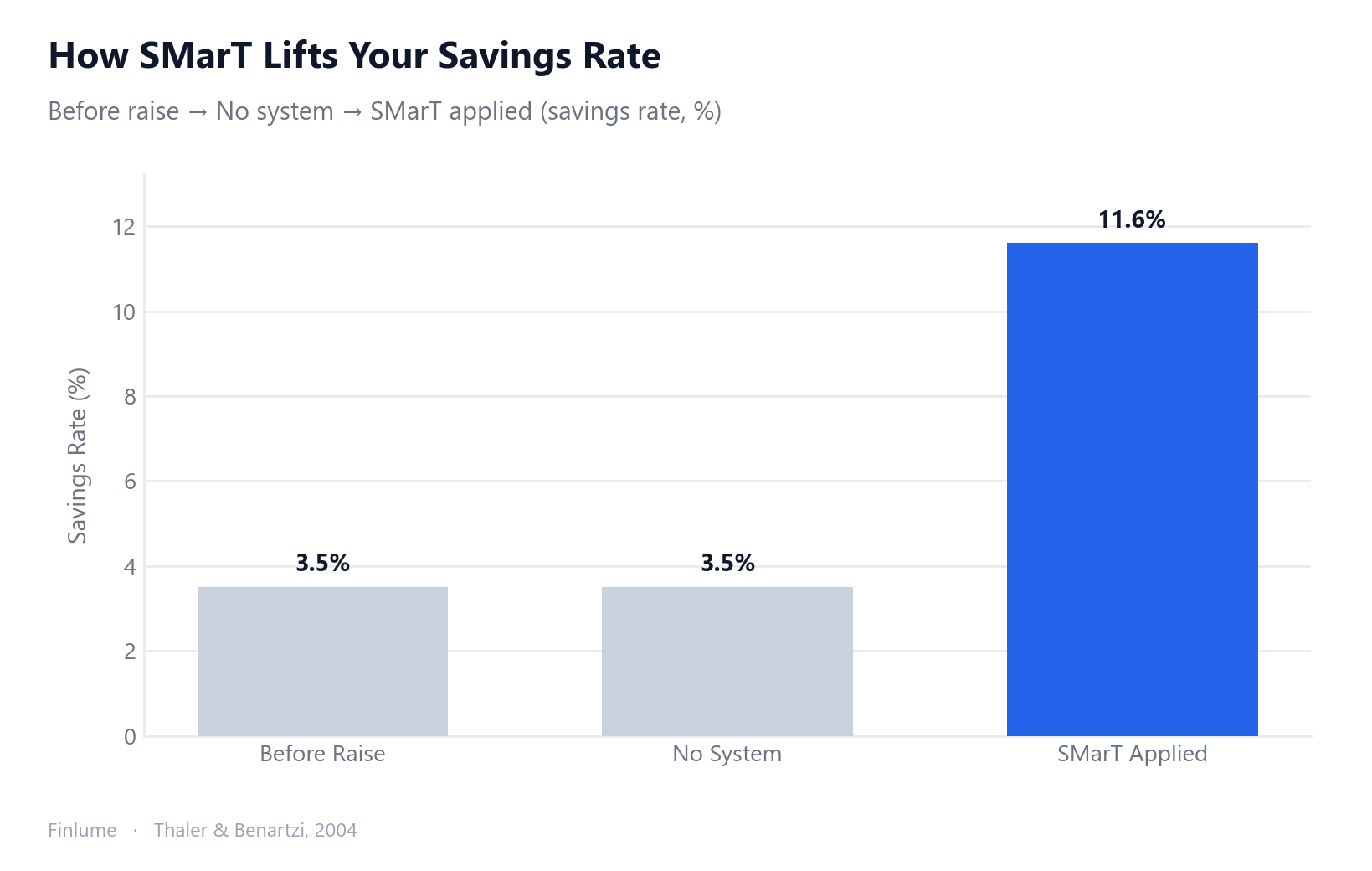
The most rigorously tested approach is SMarT — Save More Tomorrow, developed by Richard Thaler and Shlomo Benartzi in 2004. The premise is straightforward: instead of committing to save more right now (psychologically hard), you pre-commit to directing a portion of your future raises into savings automatically. In their research, participants who followed this approach saw their average savings rate climb from 3.5% to 11.6%. The key insight is loss aversion: you never “feel” the money being taken away because you never had it in your spending baseline to begin with.
Here’s how to put it into practice:
| Strategy | How to Apply | Why It Works |
|---|---|---|
| 50% raise rule | When you get a raise, auto-route at least 50% of the increase to savings immediately | Captures the gain before the lifestyle upgrades do |
| Savings rate ratchet | Each raise, bump your savings rate by 1–2 percentage points | Gradual, so the budget impact feels minimal |
| Quarterly subscription audit | Every three months, list every recurring charge and ask “would I pay for this again today?” | Makes invisible fixed costs visible |
| Satisfaction check | For any upgrade, revisit after 6 months — is it still delivering real value? | Self-test for hedonic adaptation |
Automation is the load-bearing piece here. “I’ll adjust it later” almost always means “I won’t.” The moment you get that raise notification, that’s when you open the app and change the automatic transfer amount. Not next week. That day.
One more thing worth saying: this isn’t about living like an ascetic. The research on spending and happiness generally suggests that experiences — relationships, learning, travel — tend to deliver more durable satisfaction than material upgrades. So the goal isn’t to spend less, necessarily. It’s to spend deliberately, on things that don’t just adapt away.
If impulsive upgrades are part of the problem, the psychology behind impulse buying digs into why these decisions happen and how to interrupt them. And once you know how much to save, figuring out your actual target savings rate gives you a concrete number to aim for when the next raise arrives.
The Raise You Never Invest: A Compounding Cost Calculator
The strategies above tell you what to do. This section quantifies what it costs not to do it — in terms of foregone wealth, using arithmetic alone (no invented statistics).
Setup: Assume your raise is worth 1 unit per year (currency-neutral — it could be $1,000, €1,000, or ¥100,000; the ratios are the same). You invest whatever fraction you capture at a 7% annual return. The table below shows how many times that one annual raise amount you accumulate, depending on how much you redirect and how long you let it compound.
| Raise captured for savings | After 10 years | After 20 years | After 30 years |
|---|---|---|---|
| 0% (fully absorbed by lifestyle) | 0.0× | 0.0× | 0.0× |
| 25% saved | 3.5× | 10.2× | 23.6× |
| 50% saved (the 50/50 rule) | 6.9× | 20.5× | 47.2× |
| 75% saved | 10.4× | 30.7× | 70.8× |
| 100% saved | 13.8× | 41.0× | 94.5× |
Assumptions: 7% annual return, contributions made at end of each year (ordinary annuity), compounded annually. Illustrative only.
Two things stand out. First, the 50/50 rule — spending half the raise freely, investing the other half — still produces 20.5× the raise amount after 20 years. If that raise unit is $5,000, after 20 years the invested half has grown to over $102,000. The lifestyle upgrade you funded with the other half? You adapted to it within a few months. Second, the difference between 0% and 50% captured is not gradual — it is absolute. Lifestyle creep doesn’t just slow your wealth-building; for the portion of the raise it absorbs, it eliminates the compounding entirely.
This is the hidden math behind the 50% raise rule. The argument isn’t that you should live like a monk — it’s that hedonic adaptation makes the spending half temporary, while compounding makes the invested half permanent.
Key Takeaways
- Lifestyle creep: income rises, spending rises in lockstep, savings rate stays flat or falls. Gradual and largely invisible.
- Hedonic adaptation: consumption upgrades deliver temporary satisfaction, then you adapt. The spending stays; the happiness boost fades.
- Social comparison: as your reference group shifts, your spending benchmark shifts with it — often without conscious awareness.
- SMarT strategy: pre-commit future raises to savings before the money hits your lifestyle. Savings rate went from 3.5% to 11.6% in Thaler & Benartzi’s research.
- Practical rule: direct at least 50% of every raise to savings on the day you receive it. Audit subscriptions every quarter.
- The compounding cost: every unit of raise fully absorbed by lifestyle forgoes 20.5× in wealth over 20 years (at 7%). Even the 50/50 split builds 20.5× the invested portion — while hedonic adaptation erodes the enjoyment from the spent half within months.
If your raise isn’t showing up in your net worth, you don’t have a discipline problem — you have a system problem. Fix the system first, and discipline gets a lot easier.
Frequently Asked Questions
What is lifestyle creep?
Lifestyle creep is the pattern where your spending rises in lockstep with your income, absorbing the extra take-home pay before it reaches your savings. It happens gradually through small upgrades to subscriptions, dining, and daily habits, which is why most people don’t notice it until months later.
Why is lifestyle creep so hard to avoid?
Two psychological mechanisms drive it. Hedonic adaptation means any consumption upgrade feels good briefly, then becomes the new normal — the satisfaction fades but the higher spending stays. Social comparison means your spending benchmark shifts upward as your peer group changes with your income, often without conscious awareness.
What is the SMarT strategy and does it work?
SMarT (Save More Tomorrow) was developed by Richard Thaler and Shlomo Benartzi in 2004. Instead of cutting spending now, you pre-commit to directing a portion of future raises into savings automatically. In their research, participants’ average savings rate climbed from 3.5% to 11.6%.
What is the simplest way to stop lifestyle creep?
On the day you receive a raise notification, immediately set up an automatic transfer of at least 50% of the increase to savings. Capturing it before it enters your spending baseline is the key. Also audit your subscriptions every quarter to catch silent fixed costs creeping in.
Does earning more money actually make you happier?
Research by Kahneman, Deaton, and Killingsworth shows the relationship between income and happiness is not linear. Beyond a certain level, more income does not reliably improve day-to-day wellbeing, largely because hedonic adaptation erodes the gains from higher spending fairly quickly.