How to Split Your Paycheck with the 50/30/20 Budget Rule
There was a stretch in my twenties where my account was empty a week after payday and I genuinely could not tell you where it went. I tried the detailed, line-by-line budget. I lasted about three days. Then I found the 50/30/20 rule. Three buckets, that’s it — which is exactly why a lazy budgeter like me has actually stuck with it for years.
1. What the 50/30/20 Rule Is — One-Line Definition and Origin
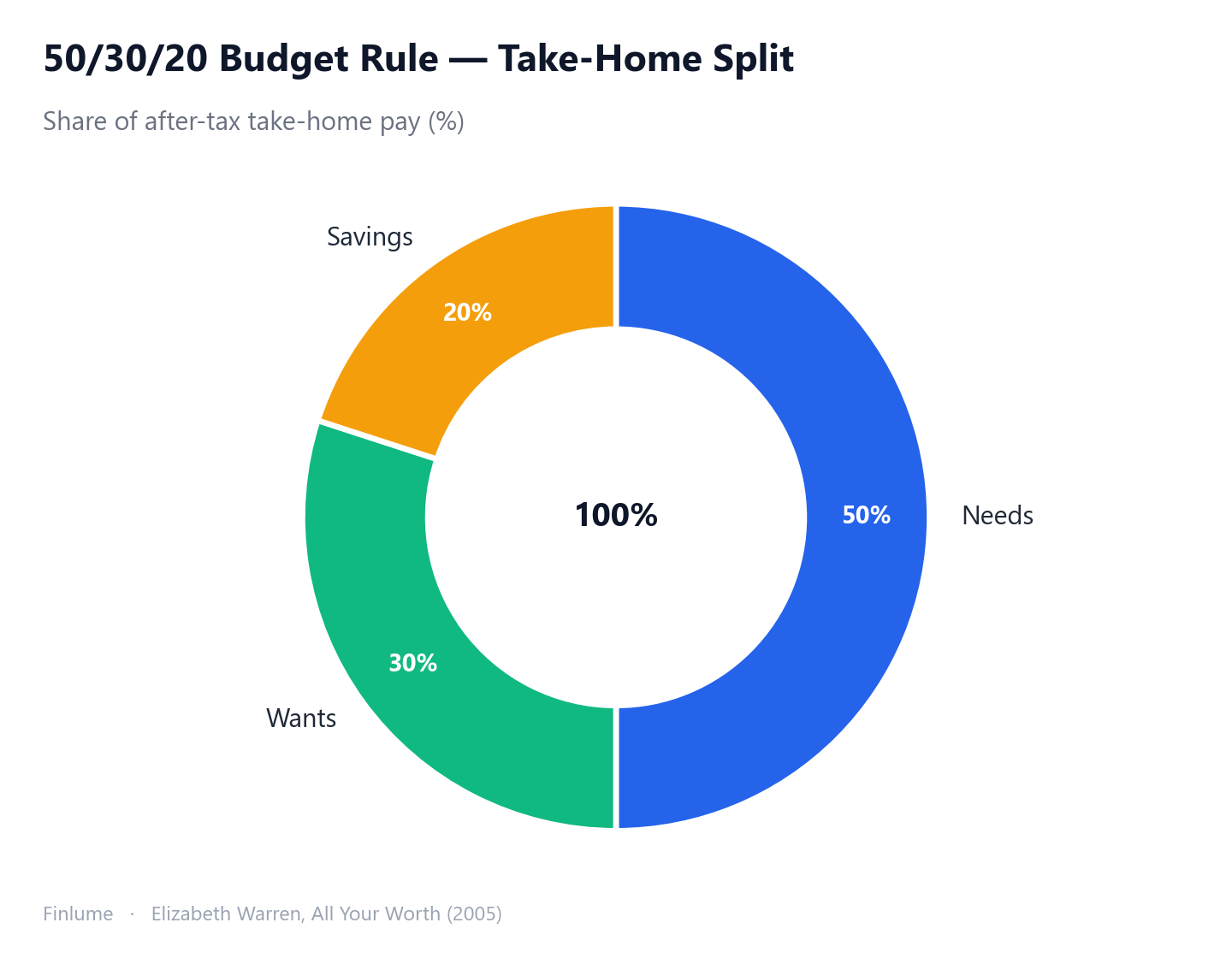
In one line: it’s a simple budget that splits your after-tax income into Needs 50%, Wants 30%, and Savings & Debt 20%.
The formula was popularized by U.S. Senator Elizabeth Warren and her daughter, Amelia Warren Tyagi, in their 2005 book All Your Worth: The Ultimate Lifetime Money Plan. They called it the “balanced money formula,” and the ratio they laid out was exactly 50/30/20. It’s less a piece of financial theory and more a gut-level instruction: divide your money into three envelopes and stop overthinking it.
2. The Most Important Rule: Use Take-Home Pay, Not Gross
This is where most people trip. The 50/30/20 split is based on your take-home pay — the money that actually lands in your account after taxes and mandatory deductions — not your gross salary.
Run it off your gross number and every ratio is off from the start. So find what hits your account each month first. Tax and social-insurance systems differ from country to country, so just think of it as “what’s left after everything gets taken out, the amount you can actually touch.” That number is your starting line.
3. Sorting the Three Buckets Correctly (Needs / Wants / Savings)
| Bucket | Share | What goes in |
|---|---|---|
| Needs | 50% | Housing (rent or mortgage principal + interest), utilities (electric, water, gas), basic groceries, commuting costs, phone/internet, insurance, essential healthcare, the minimum required payment on any debt |
| Wants | 30% | Dining out and delivery, travel, hobbies and leisure, streaming subscriptions, non-essential shopping, the extra you pay to choose a pricier brand |
| Savings | 20% | Emergency fund, investing, retirement saving, any debt payment above the minimum |
A clean test: Needs are “things that go wrong if you skip them,” Wants are “nice to have but you’d survive without them.” That sorts most line items in seconds.
The one that trips everyone: a debt’s minimum required payment goes in Needs (50%), while anything you pay above that minimum goes in Savings (20%). The minimum is a fixed obligation you can’t skip, so it’s a Need; paying extra is a choice you make for your future, so it’s Savings.
4. Running the Numbers — Worked Examples by Paycheck
Numbers beat words here. You just multiply your take-home pay.
| Take-home (monthly) | Needs 50% | Wants 30% | Savings 20% |
|---|---|---|---|
| $2,500 | $1,250 | $750 | $500 |
| $3,000 | $1,500 | $900 | $600 |
| $4,000 | $2,000 | $1,200 | $800 |
At $3,000, that’s 1,500 + 900 + 600 = $3,000 — exactly 100%. Since 0.5 + 0.3 + 0.2 = 1.0, the three buckets always add back up to your full take-home, whatever the number. You barely need a calculator.
5. Why the 50/30/20 Rule Works for Beginners
- It’s simple. You watch three buckets instead of chasing forty categories. That’s why it lasts — the budget you don’t quit is the one that wins.
- It’s balanced. It doesn’t only nag you about the future (Savings 20%); it builds today’s enjoyment (Wants 30%) right into the plan.
- Guilt-free spending. If it’s inside the 30%, spend it without flinching. Your savings and needs are already handled. If that Wants bucket keeps leaking, these psychology-backed ways to curb impulse buying pair well with the rule.
If three buckets still feel too loose, you can level up to zero-based budgeting, which gives every dollar a job. And if you’re wondering what that 20% should really be, the guide on what savings rate to aim for digs into the number.
6. Limits and Caveats — It’s Not Right for Everyone
It’s a good tool, not a magic one. Let me be straight about where it breaks.
- High-cost regions. Housing alone can blow past 50% of take-home. When that happens, “Needs 50%” simply isn’t realistic.
- Lower incomes. When income is tight, essentials alone can sail past 50%, leaving little room for Wants or Savings. Here the rule works only as a target to grow toward, not a present-day cap.
- Higher incomes. You don’t have to spend a full 50% on Needs. Pushing your savings rate well above 20% is the smarter move.
- Aggressive goals. If you’re building wealth fast or paying down debt early, 20% to savings may not be enough.
7. Adjust It to Your Life + One Practical Tip
The ratios aren’t commandments. Variations like 70/20/10, 60/20/20, and 80/10/10 all exist. The real point is the three-bucket frame; tune the percentages to your housing burden, debt, and income level. If you have no idea where to begin, begin at 50/30/20.
One last tip. When your pay arrives, move the savings 20% out first, by automatic transfer. Don’t save what’s left after spending — spend what’s left after saving. This is “pay yourself first.” We tend to spend whatever we can see in the account, so the surest fix is to make that money disappear before you ever touch it.
8. What the 20% Actually Builds — Long-Run Wealth by Savings Rate
The worked examples in Section 4 show what you set aside each month. What they don’t show is where those monthly amounts end up decades later. Here’s that picture, computed for four common savings rates at a 7% annual return assumption (a widely cited long-run real-asset average — treat it as an illustration, not a guarantee).
Table: Accumulated wealth as a multiple of your monthly take-home pay
| Savings rate | Monthly set aside | After 10 years | After 20 years | After 30 years |
|---|---|---|---|---|
| 10% (one-half the 20% rule) | 10 / 100 units | 17.1× | 50.8× | 116.9× |
| 20% (50/30/20 baseline) | 20 / 100 units | 34.2× | 101.5× | 233.9× |
| 25% | 25 / 100 units | 42.8× | 126.9× | 292.4× |
| 30% | 30 / 100 units | 51.3× | 152.3× | 350.8× |
Assumptions: contributions start immediately, monthly compounding, 7% annual return, no taxes on growth shown. Real returns and tax treatment vary — use this as an order-of-magnitude guide, not a projection.
Two observations worth sitting with. First, cutting savings from 20% to 10% doesn’t just halve your monthly contribution — it halves the entire 30-year pile (116.9× vs 233.9×), because future value scales linearly with the contribution amount. Second, every 5 percentage points you add above the 20% baseline tacks on roughly 58–60 additional monthly take-home units of wealth after 30 years. That extra 5% feels small month to month; over three decades it compounds into a meaningful difference.
The 50/30/20 rule’s 20% floor is a solid starting point, not a ceiling. If your Needs genuinely fit inside 50% and you still have room in Wants, the table above makes the arithmetic case for redirecting some of that surplus to Savings rather than spending it.
Key Takeaways Checklist
- Base it on take-home pay, not gross
- Split into Needs 50 / Wants 30 / Savings 20
- A debt’s minimum payment is a Need; extra payments are Savings
- Adjust the ratios to your situation (just start at 50/30/20)
- Pull the savings out first, automatically, on payday
- The 20% is a floor, not a ceiling — each extra 5% saved adds ~58–60× monthly income in 30-year wealth (at 7% return)
A system that keeps running beats a perfect ratio that you abandon. Start today by multiplying your take-home by 0.5, 0.3, and 0.2. That one small calculation gets you further than you’d expect.
Frequently Asked Questions
Q. Is the 50/30/20 rule based on gross income or take-home pay?
It’s based on take-home pay — the money that actually lands in your account after taxes and mandatory deductions — not your gross salary. Run it off your gross number and every ratio is off from the start, so find what hits your account each month first.
Q. Does paying down debt count as a Need (50%) or Savings (20%)?
It splits. A debt’s minimum required payment is a fixed obligation you can’t skip, so it goes in Needs (50%). Anything you pay above that minimum is a choice you make for your future, so it goes in Savings (20%).
Q. What if my rent pushes Needs above 50%?
In high-cost regions or on lower incomes, housing alone can blow past 50% of take-home, so “Needs 50%” isn’t always realistic. Treat 50/30/20 as a target to grow toward rather than a present-day cap, and adjust with variations like 70/20/10 or 60/20/20.
Q. How do I split a $3,000 take-home paycheck?
Needs $1,500, Wants $900, Savings $600. Just multiply your take-home by 0.5, 0.3, and 0.2 — the three buckets always add back up to your full take-home.
Q. What’s the easiest way to actually save the 20%?
Move the savings 20% out first, by automatic transfer, the moment your pay arrives — the “pay yourself first” approach. Don’t save what’s left after spending; spend what’s left after saving.