Your Coast FIRE Number: How to Calculate the Point Where Compound Interest Does the Work
There’s a specific moment I’ve watched people describe over and over in FIRE communities: they’re updating their spreadsheet, run the numbers one more time, and realize — wait, I don’t need to add anything else. If this money just sits here and compounds, I hit my target at retirement. No further contributions required.
That’s Coast FIRE. And the math behind it is surprisingly approachable once you see how the formula works. This article walks you through the concept, the formula, what realistic age-based numbers look like, and — critically — the three assumptions that can quietly derail your calculation.
What Coast FIRE Actually Means — The Compound Interest Threshold
Coast FIRE is the point at which your current investment portfolio, growing without any additional contributions, will compound to your full retirement target by the time you plan to stop working. You’ve essentially “launched” your money and can now let it coast to the finish line.
A few things Coast FIRE is not:
- It is not retirement. You still need to cover living expenses from your own income.
- It is not a guarantee. It’s a projection based on assumed returns.
- It is not the finish line. It’s a milestone on the path to full financial independence.
Here’s how it fits within the broader FIRE landscape:
| FIRE Type | Concept | How Living Expenses Are Covered |
|---|---|---|
| Lean FIRE | Minimal spending, small portfolio, full retirement | Portfolio withdrawals only |
| Barista FIRE | Portfolio covers 60–80% of costs; part-time work fills the gap | Withdrawals + part-time income |
| Coast FIRE | Portfolio already on track to hit target with no new contributions | Fully self-funded from work |
| Fat FIRE | High spending, large portfolio, full retirement | Portfolio withdrawals only |
The shift at Coast FIRE is a freedom of pressure, not freedom from work. Many people use it as the trigger to take a lower-stress job, shift careers, or reduce hours — because the retirement math no longer demands a high salary.
The Formula — Three Steps to Your Coast FIRE Number
There’s only one formula to know:
Coast FIRE Number = FI Number ÷ (1 + r)^n
- FI Number: Your total portfolio target at retirement (annual expenses × 25)
- r: Real annual return rate (after inflation)
- n: Years until your target retirement age
Step 1: Calculate your FI Number Multiply your expected annual retirement spending by 25. This is the 4% rule in reverse — 1 ÷ 0.04 = 25. The 4% rule traces back to financial planner William Bengen’s 1994 paper in the Journal of Financial Planning, later validated in 1998 by the Trinity Study, which found a 95% success rate over 30 years with a 50/50 stock-bond portfolio at 4% annual withdrawals.
- Example: $60,000/year spending → FI Number = $60,000 × 25 = $1,500,000
Step 2: Fix your time horizon (n) Target retirement age minus current age. Example: current age 35, target retirement 65 → n = 30 years.
Step 3: Solve for your Coast FIRE Number
- $1,500,000 ÷ (1.07)^30 = $1,500,000 ÷ 7.612 = $197,000
If you have $197,000 invested at 35 and never add another dollar, historical S&P 500 real returns suggest that money reaches $1,500,000 by age 65. That’s your Coast FIRE number.
For a deeper look at the FI Number itself and how withdrawal rates affect it under different scenarios, see How Much Do You Really Need to Retire? The 25x Rule.
Coast FIRE Numbers by Age — Why Starting Earlier Is Mathematically Powerful
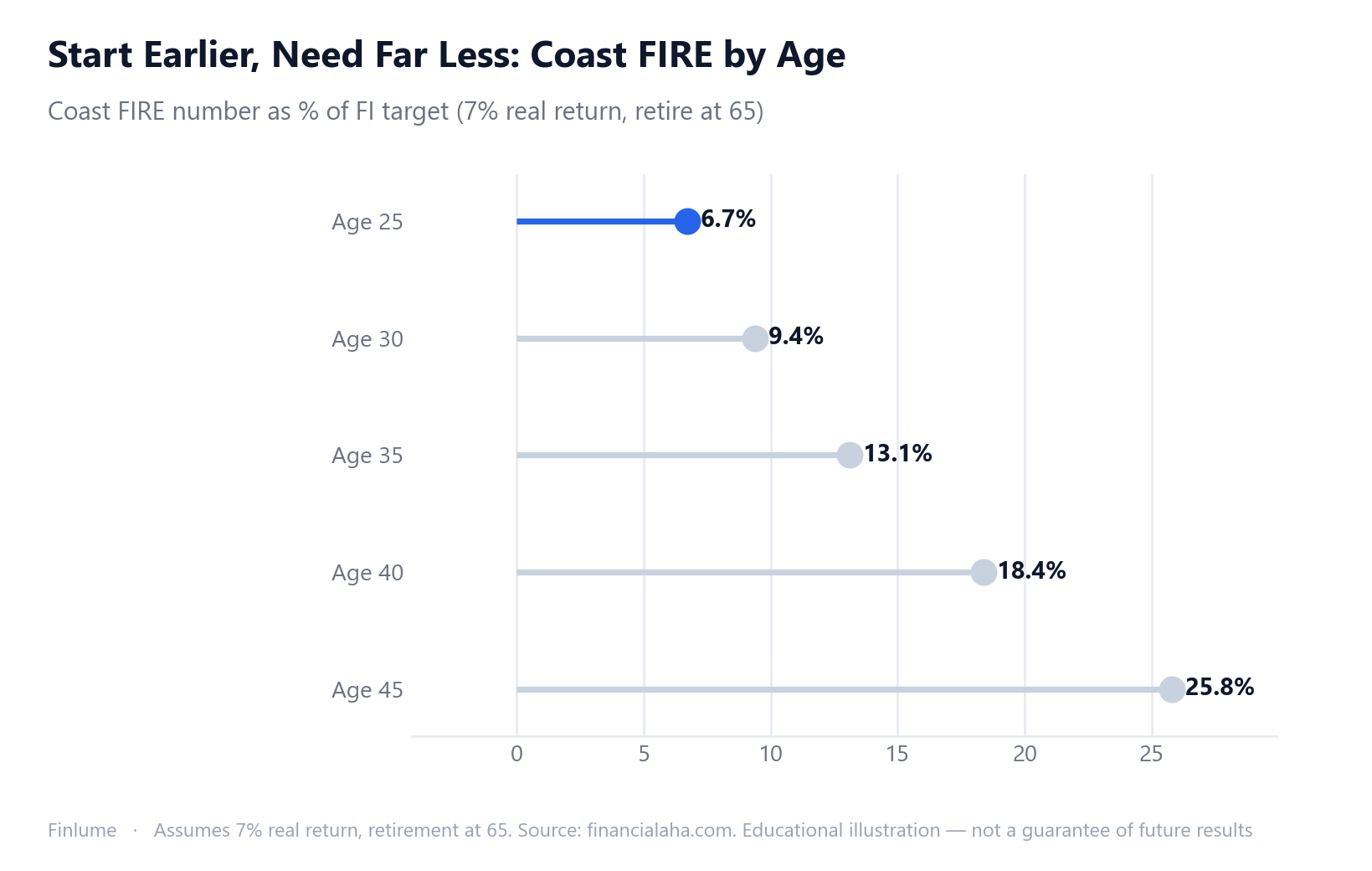
Using a real return of 7% and a target retirement age of 65, here’s what percentage of your FI Number you need at each age:
| Current Age | Years Remaining | Coast Number as % of FI | Example (FI = $1,250,000) |
|---|---|---|---|
| 25 | 40 years | 6.7% | ~$83,700 |
| 30 | 35 years | 9.4% | ~$117,500 |
| 35 | 30 years | 13.1% | ~$164,000 |
| 40 | 25 years | 18.4% | ~$230,000 |
| 45 | 20 years | 25.8% | ~$322,500 |
(7% real return assumption. Calculation basis: financialaha.com)
The gradient here is stark. A 25-year-old needs just 6.7% of their FI Number — roughly $83,700 on a $1.25M target. Wait ten years and it nearly doubles to 13.1%. That’s not motivation talk; it’s the math of compounding over a shorter runway. For a deeper look at why compound interest accelerates so dramatically over time, see Why Compound Interest Takes Decades to Pay Off.
I’ve seen people who were two or three years away from their Coast FIRE number at 30 pivot to a less demanding role once they crossed it — and the relief was palpable. The retirement plan hadn’t changed at all. What changed was that they no longer needed the next raise.
The Return Assumption — The Variable That Moves Everything
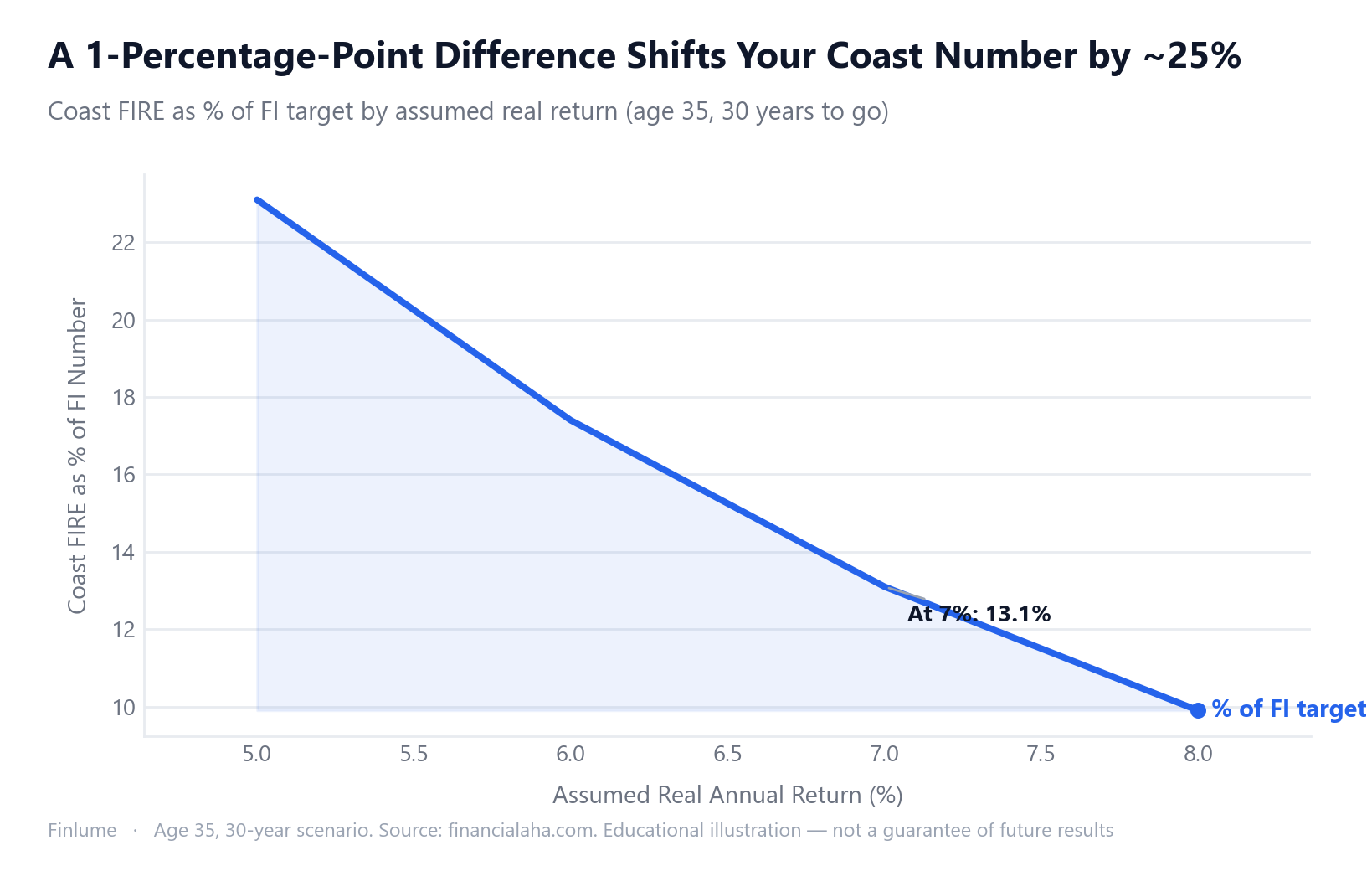
The return rate you plug into the formula determines your Coast FIRE number more than any other input. Here’s the sensitivity, using age 35, FI Number = $1,250,000, 30 years:
| Real Return Rate | Coast FIRE Number | % of FI Number |
|---|---|---|
| 5% | $289,300 | 23.1% |
| 6% | $217,650 | 17.4% |
| 7% | $164,260 | 13.1% |
| 8% | $124,440 | 9.9% |
(Source: financialaha.com)
A 1 percentage point difference shifts the required number by roughly 30–33%. This is not a rounding error — it’s the difference of tens of thousands of dollars in required savings.
Where does 7% real come from? According to S&P 500 historical return data, the 30-year nominal average return is approximately 10.12%, and the inflation-adjusted real return is approximately 7.43%. The 7% assumption comes from rounding that long-run figure.
The honest interpretation: 7% real is what the past delivered, not what the future guarantees. I run two scenarios on any Coast FIRE projection — 7% as the baseline, and 5–6% as the conservative case. If the conservative number is still achievable, I feel a lot better about the plan.
Practical note: these figures are pre-tax and pre-fee. Your actual net return will be lower once fund expense ratios and any applicable taxes are factored in. US-listed ETFs like VOO or VTI offer low-cost exposure to the S&P 500, but 4% and 7% assumptions are drawn from US market history — applying them to a global portfolio requires a judgment call. For a precise look at how fee differences compound over decades, see ETF Expense Ratios: How a Small Fee Gap Steals Years of Growth.
The Rule of 72 makes the compounding intuitive: at 7%, money doubles roughly every 10.3 years. At 35 with $164,260: 45 → $328,500; 55 → $657,000; 65 → $1,314,000. That’s how coasting works.
What to Do After Hitting Coast FIRE — It’s Not About Quitting
Reaching Coast FIRE doesn’t mean handing in your notice. It means the pressure to maximize savings rate dissolves. The decisions available to you look different than they did before.
Three common transitions:
1. Full-time to part-time Drop hours, move to lower-stress work. Your retirement math no longer requires a high income — it just needs enough to cover today’s expenses.
2. Career pivot Lower-paying but more meaningful work — teaching, nonprofits, creative fields — becomes viable when compound interest has already been assigned its job. The salary gap stops being disqualifying.
3. Geographic arbitrage Moving to a lower cost-of-living area reduces what you need to earn. Since no additional contributions are required, the income bar drops to living expenses only.
The risks here are real and deserve honest accounting. Job loss, unexpected medical costs, a recession that drags down market values precisely when you feel most comfortable — these are all live possibilities. The coast number assumes the portfolio keeps compounding; a prolonged crash in the early years can delay the trajectory. Maintain a separate emergency fund regardless of where you stand on Coast FIRE.
Scenario Matrix: Your Coast FIRE Number Across Age and Return Rate
The two tables above each hold one variable fixed. In practice, you need to stress-test both at once. This matrix shows what percentage of your FI Number you must already have invested today, for every combination of starting age (25–50) and real return assumption (5%–8%). Retire-at-65 assumed throughout.
(All figures computed from the Coast FIRE formula: 100 ÷ (1 + r)^n. Assumed inputs only — not a guarantee of future returns.)
| Current Age | Years Left | 5% real | 6% real | 7% real | 8% real |
|---|---|---|---|---|---|
| 25 | 40 | 14.2% | 9.7% | 6.7% | 4.6% |
| 30 | 35 | 18.1% | 13.0% | 9.4% | 6.8% |
| 35 | 30 | 23.1% | 17.4% | 13.1% | 9.9% |
| 40 | 25 | 29.5% | 23.3% | 18.4% | 14.6% |
| 45 | 20 | 37.7% | 31.2% | 25.8% | 21.5% |
| 50 | 15 | 48.1% | 41.7% | 36.2% | 31.5% |
How to use this table: Find your row (current age) and read across to your chosen return scenario. Multiply your FI Number by that percentage to get your Coast FIRE target in dollars.
Example — Age 40, conservative 5%: you need 29.5% of your FI Number already invested. On a $1,000,000 FI Number, that is $295,000. Run the same row at 7% and the target drops to $184,000. The $111,000 gap between those two cells is entirely a function of which return rate proves correct over the next 25 years. You cannot control that — which is why planning at 5–6% and treating 7% as upside is the more defensible approach.
Two patterns this matrix reveals that neither single-axis table above shows:
-
The conservative penalty shrinks as you age. At 25, using 5% instead of 7% more than doubles your required Coast FIRE amount (14.2% vs. 6.7% — a 2.1× multiplier). By age 50, the same shift from 7% to 5% increases the target by only 1.3× (48.1% vs. 36.2%). With a shorter runway, there is simply less time for return-rate differences to compound.
-
Age 50 at 5% real requires nearly half your FI Number already in place. If you are 50, using a conservative return assumption, and have not yet reached Coast FIRE, you are no longer in coast territory — you are in active accumulation territory for the remaining 15 years. That is a fundamentally different planning situation than the same age at a 7–8% assumption.
Three Traps That Quietly Break the Calculation
Trap 1 — Inflated return assumptions The S&P 500’s 10-year nominal return has been 15.62%. Using that as your “r” because it’s recent produces a Coast FIRE number that looks comfortably achievable — and is probably too optimistic. The 30-year historical average is closer to 10% nominal, 7.4% real. Use long-run averages, not recent performance.
Trap 2 — Locking in today’s spending Life gets more expensive. Marriage, children, health costs, supporting aging parents — these shift the FI Number upward. “Annual expenses × 25” is a starting point, not a permanent calculation. Revisit it every few years.
Trap 3 — Mixing nominal and real returns Using a 10% nominal return rate and a today-dollars FI Number double-counts inflation. Use real returns (7%) with a present-value FI Number, or nominal returns (10%) with a future-value FI Number — never mix the two. This is the most common arithmetic mistake I see in Coast FIRE calculations.
One broader caveat: the 4% rule and 7% real return assumption are both derived from U.S. market data. Applying them without adjustment to a globally diversified portfolio may overestimate sustainable outcomes in scenarios where U.S. markets underperform historical norms. The related risk — how a market downturn in the first years of retirement can derail even a well-funded plan — is covered in depth in Sequence of Returns Risk Explained.
Checklist: Coast FIRE in Six Steps
- Calculated FI Number = estimated annual retirement spending × 25
- Applied Coast FIRE formula: FI Number ÷ (1 + r)^n using your current age and target retirement age
- Used real (inflation-adjusted) return, with a conservative 5–6% scenario alongside the 7% base case
- Confirmed that living expenses still need to be self-funded after reaching Coast FIRE
- Accounted for potential spending increases, taxes, and fees not in the base calculation
- Checked for the three traps: inflated returns, fixed spending, nominal/real mix-up
- Cross-checked your Coast FIRE target in the scenario matrix at both 7% and 5–6% real return
Coast FIRE is not a consolation prize. It’s the signal that compound interest has officially been handed its assignment. From there, you can make decisions about work, income, and time based on what you actually want — not what the retirement calculator demands. That’s a genuinely different kind of freedom.
Frequently Asked Questions
Does reaching Coast FIRE mean I can stop working?
No. Coast FIRE means your portfolio will compound to your retirement target without new contributions — it does not mean you can cover today’s living expenses from investments. You still need to earn your own income. What changes is the pressure to save aggressively, not the need to work.
What return rate should I use for Coast FIRE calculations?
The standard baseline is 7% real (inflation-adjusted), derived from S&P 500 long-run historical data of approximately 10% nominal and 7.4% real. Always run a conservative scenario at 5–6% alongside the baseline. Never mix nominal and real return rates in the same calculation.
What is the difference between Coast FIRE and Barista FIRE?
Coast FIRE means your portfolio is already on track to hit your retirement target with no new contributions; you earn 100% of living expenses from work. Barista FIRE means your portfolio covers roughly 60–80% of expenses and part-time work fills the gap. Coast is about removing savings pressure; Barista is a hybrid semi-retirement.
How does the 25x rule (4% rule) feed into Coast FIRE math?
The 25x rule gives you your FI Number first: multiply expected annual retirement spending by 25. That FI Number is then discounted back to present value using the Coast FIRE formula: FI Number divided by (1 + r)^n. For example, $60,000/year spending produces a $1.5M FI Number; at age 35 with 30 years to go, that discounts to roughly $197,000.
How do I check whether I have already reached Coast FIRE?
Multiply your current invested assets by (1 + r)^n and compare to your FI Number. If current assets × (1.07)^n is greater than or equal to your FI Number, you have hit Coast FIRE. At age 35 with $197,000 invested and a $1.5M FI Number: $197,000 × (1.07)^30 is approximately $1.5M, confirming you are at Coast FIRE.
This article is for general informational purposes only and does not recommend any specific investment product or security. All investing carries the risk of loss of principal. Figures are based on historical data and modeling assumptions; they do not guarantee future returns. All figures are pre-tax; actual after-tax outcomes vary by jurisdiction and individual circumstances. Investment decisions are your own responsibility.