How Much Do You Really Need to Retire? The 25x Rule (and When It's Not Enough)
How much do you actually need to retire? Strip away the noise and it comes down to one formula: annual spending × 25. That’s it.
Behind that deceptively simple equation, though, lies nearly a century of market data and thousands of simulations. And whether 25x is truly enough for you depends on when you retire, how long you live, and — crucially — the order in which your returns arrive. I still remember the first time I ran the numbers for myself. The target was bigger than I expected. But once you have a concrete number, at least you know what you’re running toward.
What the 25x Rule Is — And Its Relationship to the 4% Rule
The math is straightforward.
Retirement target = annual spending × 25 Annual safe withdrawal = portfolio × 4%
These two formulas are the same equation flipped front-to-back. 1 ÷ 0.04 = 25. The idea is that if you withdraw 4% of your portfolio in year one of retirement — then adjust that amount for inflation every year afterward — history says your money survives for at least 30 years across most market scenarios.
In practice, I find the 25x framing more intuitive than the 4% rule. Starting from your spending, the number lands immediately. If you spend $48,000 a year, your target is $1,200,000. If that feels distant, it’s also a useful signal to examine what’s driving your spending.
Practical tip: Your retirement spending probably won’t be identical to today’s. The first decade (the “go-go years”) often runs higher than expected — travel, hobbies, deferred projects. Factor in a ±10–20% adjustment rather than locking in today’s figure.
The Origin: Bengen 1994 and the Trinity Study
This formula isn’t someone’s opinion. It comes from historical data.
According to the 4% rule’s documented history, financial planner William Bengen analyzed U.S. market returns going back to 1926. Using a portfolio of 50% large-cap U.S. stocks and 50% intermediate-term bonds, he found that the highest withdrawal rate that had never failed over any 30-year historical period was 4% — what he called the SAFEMAX (Safe Maximum).
In 1998, three professors at Trinity University (Cooley, Hubbard, and Walz) independently validated Bengen’s findings using data from 1926 to 1995. Their paper became known as the Trinity Study, and it remains the most cited benchmark in retirement income research.
What’s interesting is that Bengen himself has kept updating his own rule. Adding small-cap stocks lifted the SAFEMAX to 4.3%, then 4.5%. In his 2025 book A Richer Retirement, he argues that a broadly diversified portfolio — including mid-cap, small-cap, and micro-cap stocks — supports a SAFEMAX of 4.7%. A rule that’s survived 30 years of scrutiny and multiple market cycles earns a certain kind of respect.
Two important caveats, though:
- 4.7% is portfolio-specific: It requires the specific diversified construction Bengen describes. If you’re investing in a standard broad index fund, you can’t simply assume 4.7% applies.
- U.S. market bias: Both original studies used U.S. stock and bond data. Wade Pfau’s 2010 international analysis found that a 4% rule would have been safe in only 4 out of 14 developed countries. If you’re investing across global markets, treat this as a U.S.-centric baseline.
Calculating Your Number — Step by Step, Three Scenarios
Abstract numbers become real only when you plug in your own figures. Four steps:
- Estimate your expected annual spending in retirement (adjust from current spending)
- Multiply by 25
- If you have separate income sources (government pension, part-time work, rental income, etc.), subtract their annual amount × 25 from the total
- The result = your portfolio target
| Scenario | Annual spending | 25x target |
|---|---|---|
| Lean | $24,000/year | $600,000 |
| Standard | $48,000/year | $1,200,000 |
| Comfortable | $72,000/year | $1,800,000 |
The income offset matters more than people realize. If you expect $12,000 a year from a government pension or part-time work, that reduces your portfolio target by $12,000 × 25 = $300,000. On the standard scenario, that’s the difference between $1,200,000 and $900,000.
One thing I’ve seen trip people up: the assumption that retirement spending “automatically” drops. Research on actual retiree spending shows the opposite pattern in the early years — the go-go phase often costs more, not less. Underestimate your expenses and the entire target is wrong from the start.
For a precise simulation with your own numbers, try the retirement calculator.
Three Limits of the 25x Rule
Simple formulas omit variables. These three are the ones that matter.
Limit 1 — Inflation: The 4% rule assumes you increase withdrawals each year with inflation. If you withdraw a fixed dollar amount, purchasing power shrinks over time. At 3% annual inflation, the Rule of 72 tells us prices double roughly every 24 years. Blueprint Income’s analysis shows that at 3% inflation, purchasing power falls to about 41% of its starting value after 30 years. For a deeper look at how inflation erodes wealth over time, see How Inflation Quietly Erodes the Value of Your Savings.
| Years elapsed | Purchasing power at 2% inflation | at 3% | at 4% |
|---|---|---|---|
| 0 | 100 | 100 | 100 |
| 10 | 82 | 74 | 68 |
| 20 | 67 | 55 | 46 |
| 30 | 55 | 41 | 31 |
(Index starting at 100. Assumes zero investment returns — illustrates inflation risk in isolation.)
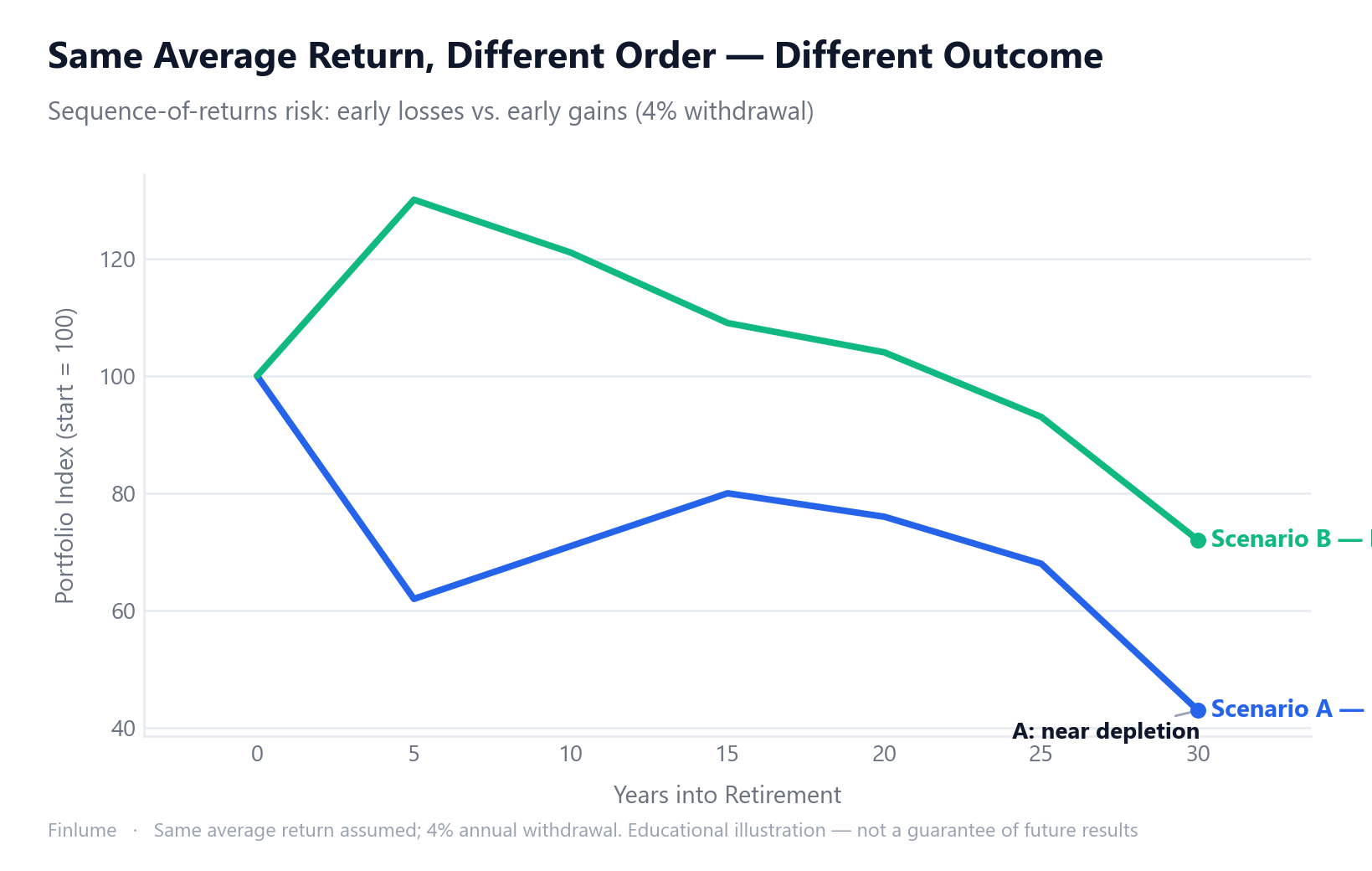
Limit 2 — Sequence of Returns Risk: This is the most underappreciated risk in retirement planning. Even if two investors earn the same average return over 30 years, the investor who experiences heavy losses in the first few years of retirement ends up far worse off.
Consider two retirees, identical portfolios, identical 30-year average returns:
- Scenario A: First three years return -15%, -10%, -5%, then recover
- Scenario B: First three years return +10%, +12%, +8%, then identical declines
Scenario A withdraws living expenses from a rapidly falling portfolio. The base shrinks before compounding can help. The result: portfolio depletion years earlier than Scenario B, despite the same average. When I first worked through this properly, it shook my confidence in simple average-return spreadsheets.
Limit 3 — Longevity: The original formula assumes a 30-year retirement. Retire at 50 or 55 and you might need 40–50 years of coverage. A 25x target built for 30 years may run short.
Morningstar’s 2025–2026 update: Morningstar’s research, using forward-looking return assumptions rather than historical data, recommends a safe withdrawal rate of 3.9% for a 30-year horizon with a balanced portfolio and a 90% success target — up from 3.7% in 2024, and reaffirmed for 2026. See: Morningstar — What’s a Safe Retirement Withdrawal Rate for 2026?. The distinction matters: 4% is drawn from historical simulation; 3.9% reflects expectations for a modestly lower-return future. More conservative? Target roughly 26x instead of 25x.
Adjusting the Multiple for Your Scenario
The longer your retirement, the higher your required multiple.
| Scenario | Retirement age | Horizon | Suggested withdrawal rate | Multiple needed |
|---|---|---|---|---|
| Standard retirement | 65 | 30 years | 4.0% | 25x |
| Conservative buffer | 65 | 30 years | 3.9% (Morningstar) | ~26x |
| Early retirement | 55 | 40 years | 3.5% | ~29x |
| FIRE (very early) | Under 50 | 45+ years | 3.0% | ~33x |
(Based on historical simulation benchmarks. Actual results depend on portfolio composition and return assumptions. Not a guarantee of future outcomes.)
The FIRE community has also developed useful variants:
| FIRE type | Concept | Target multiple |
|---|---|---|
| Lean FIRE | Minimal lifestyle, early retirement | 25–29x (lower spending reduces the number) |
| Fat FIRE | Comfortable early retirement | 33x or more |
| Barista FIRE | Semi-retirement with part-time income | 20–25x (income bridges the gap) |
If a 33x target sounds discouraging, here’s the flip side: reducing annual spending is just as powerful as increasing your savings rate. Cut $10,000 from your annual retirement budget and your target drops by $250,000. That same reduction, compounded over the years you no longer need to work, can pull your retirement date forward by several years.
For a deeper look at how savings rates drive retirement timelines, see FIRE Basics: How Financial Independence Actually Works. To understand how investment fees quietly reduce the portfolio you’re building toward, Why a 1% Fee Quietly Costs You Half Your Retirement is essential reading alongside this one. And for the full horizon-by-horizon survival data behind these withdrawal rates, see the 4% rule analysis.
Your Actual Multiple When Other Income Covers Part of the Bill
The articles and calculators you find elsewhere treat the 25x rule as if you must fund 100% of spending from your portfolio. But most real retirements involve some combination of government pension, part-time work, or rental income. When part of your spending is already covered, your required multiple drops — and the math is straightforward enough to do in your head.
The formula: Effective multiple = (1 − income offset %) ÷ withdrawal rate
So if a 20% pension covers part of your spending and you plan a 30-year retirement at 4%: effective multiple = (1 − 0.20) ÷ 0.04 = 20x, not 25x.
The table below applies this across the four withdrawal rates from the section above:
| Other income covering spending → | 4.0% rate (25x base) | 3.9% rate (~26x) | 3.5% rate (~29x) | 3.0% rate (~33x) |
|---|---|---|---|---|
| None (portfolio funds 100%) | 25.0x | 25.6x | 28.6x | 33.3x |
| 20% of spending covered | 20.0x | 20.5x | 22.9x | 26.7x |
| 40% of spending covered | 15.0x | 15.4x | 17.1x | 20.0x |
| 60% of spending covered | 10.0x | 10.3x | 11.4x | 13.3x |
(Assumes the income source is permanent for the full retirement horizon. Formula: effective multiple = (1 − offset) ÷ withdrawal rate. All inputs illustrative; not a guarantee of future outcomes.)
Three things this table shows that don’t appear in standard explainers:
First, the interaction between rate and offset matters more than either alone. A conservative early retiree using 3.0% with no other income needs 33.3x — a daunting number. But if 40% of spending is covered by a pension, the same person only needs 20x. The offset compresses the multiple non-linearly as the rate gets lower.
Second, 40% coverage is more common than it sounds. A government pension paying a modest fixed benefit, combined with one or two days of part-time work per week, can easily cover 30–40% of moderate retirement spending. In that scenario, someone retiring at 55 (3.5% rate) needs 17.1x instead of 28.6x — a meaningful difference in how many years of saving it implies.
Third, this is pre-tax. If your income source is taxable (e.g., a pension that counts as ordinary income), the net offset is smaller than the gross figure. The table gives gross fractions; adjust downward based on your expected effective tax rate on that income.
One important caveat: this formula treats the income as a flat, permanent offset. If the income source is temporary — say, part-time work that ends in ten years — the math becomes a present-value calculation rather than a simple multiple. For a rough adjustment: a temporary income stream covering the first decade of retirement is worth roughly one-third to two-fifths as much as a permanent one in terms of portfolio relief (the precise figure depends on your assumed discount rate; this is a rough heuristic, not a precise PV calculation).
Checklist: Your Retirement Number in Six Steps
- Estimated expected annual retirement spending
- Multiplied by 25 for a base target
- Subtracted any separate income (government pension, part-time, rental) × 25 from the target
- Adjusted the multiple for retirement age (65 = 25x, conservative = 26x, 55 ≈ 29x, under 50 ≈ 33x)
- Confirmed the assumption includes inflation-adjusted withdrawals
- Built in a buffer for sequence-of-returns risk
- Calculated the gap between target and current portfolio → use the retirement calculator
A big number is supposed to feel big. That’s the point — it makes the goal concrete. The moment you write down your target and your current assets, the gap between them becomes a problem you can actually solve. Start there.
Frequently Asked Questions
What is the 25x rule for retirement?
The 25x rule states that you need to save 25 times your expected annual expenses to retire. It assumes a 4% annual withdrawal rate — meaning your portfolio generates enough returns each year to cover living costs indefinitely. For example, if you spend $48,000 per year, your retirement target is $1,200,000.
Is the 25x rule still valid in 2026?
It remains a solid starting point, but Morningstar’s 2025–2026 research recommends a 3.9% safe withdrawal rate (roughly 26x) based on forward-looking return assumptions — up from 3.7% in 2024. For early retirees targeting 40+ year horizons, a 3–3.5% withdrawal rate — implying 29–33x — is increasingly recommended.
What is sequence of returns risk?
Sequence of returns risk is the danger that poor market returns in the first few years of retirement — even with a good long-run average — can permanently deplete your portfolio. Withdrawing living expenses from a falling portfolio reduces the base before compounding can help, leading to depletion years earlier than projected.
How do I calculate my retirement number?
Estimate your annual expenses in retirement and multiply by 25. If you have predictable separate income (government pension, part-time work, rental income), subtract that annual amount multiplied by 25 from your total target. That gives you the portfolio gap you need to fill yourself.
What if I retire early — do I need more than 25x?
Yes. For a 40–50 year retirement, most FIRE practitioners use a 3–3.5% withdrawal rate, which implies saving 29–33x your annual expenses instead of 25x. If you plan to retire before 50, targeting 33x or more is the safer benchmark.
This article is for general informational purposes only and does not recommend any specific investment product or security. All investing carries the risk of loss of principal. Figures are based on historical data and modeling assumptions; they do not guarantee future returns. All formulas are pre-tax; actual after-tax outcomes vary by jurisdiction and individual circumstances. Investment decisions are your own responsibility.