Robo-Advisor vs DIY Investing: 5 Questions That Actually Decide It
Let me cut straight to it: there’s no universal answer to whether a robo-advisor or DIY investing is better. The most expensive choice isn’t the one with the higher fee — it’s the one made without understanding your own behavioral patterns. How do you react when your portfolio drops 25%? How many hours a month are you genuinely willing to spend on this? Until you answer those questions, fee comparisons are just noise.
If you’re already familiar with the mechanics of asset allocation basics, this article gives you the decision framework for the next step: choosing how to implement it.
What a Robo-Advisor Actually Does
A robo-advisor isn’t just “auto-pilot for your money.” It performs four specific functions that replace work you’d otherwise do manually.
Automated portfolio construction. Based on a risk-tolerance questionnaire, the system builds a diversified portfolio across asset classes — typically stock and bond ETFs spanning different geographies and market caps. No research required on your part.
Systematic rebalancing. When market movements push your allocations away from targets, the robo-advisor rebalances automatically. Vanguard Digital Advisor, for example, monitors daily and rebalances whenever any allocation drifts more than 5 percentage points from target. This is the kind of discipline that most self-directed investors intend to keep but often don’t.
Automated contributions (DCA). Link a bank account, set a schedule, and regular purchases happen without you logging in. This mechanical consistency removes one of the most destructive decisions investors make — waiting for a “better entry point.”
Tax-efficiency algorithms. Many services offer tax-loss harvesting: selling positions that have declined to realize losses that can offset gains elsewhere, reducing your tax burden. Note that the value of this technique depends entirely on your home country’s tax laws — treat it as a general mechanism, not a guaranteed benefit, and verify how it applies to your situation.
The median management fee for robo-advisors runs around 0.25% per year, with most services in the 0.20–0.50% range (Morningstar 2024). This is layered on top of the ETF expense ratios inside the portfolio.
What DIY Investing Actually Requires
DIY’s headline advantage is simple: the expense ratio on a broad-market index ETF runs 0.03–0.20% per year. In the U.S., funds like VOO or VTI sit at 0.03–0.04%. That’s the number DIY proponents lead with, and it’s real.
But the lower fee comes with three genuine requirements.
Time. Managing your own portfolio means checking allocations, executing rebalancing trades, and staying current on what you hold — roughly 1–2 hours per month at minimum for a simple ETF portfolio. It’s not a lot, but “I’ll get around to it” is a common failure mode. A portfolio that hasn’t been rebalanced in three years isn’t cheap — it’s drifted.
Knowledge. You need to understand portfolio rebalancing, how to compare expense ratios and tracking differences, and how to construct a diversified allocation without accidentally doubling up on correlated positions. None of this is rocket science, but it does take deliberate learning.
Emotional control. This is the requirement most DIY investors underestimate. When your portfolio is down 30%, you’re the one who has to look at the screen and decide not to sell. There’s no algorithm absorbing that impulse for you. I’ve watched this play out repeatedly — the investor who did the most research and had the lowest fees still underperformed because they made one bad call at exactly the wrong moment.
Customization freedom. On the upside: full control. You can tilt toward specific regions, sectors, or factor exposures that a standard robo portfolio won’t offer. If you have a clear investment thesis, DIY is the only way to execute it precisely.
The Cost Layers: How Fees Compound Over 20–30 Years
Fees look small in any given year. Over decades, they’re anything but.
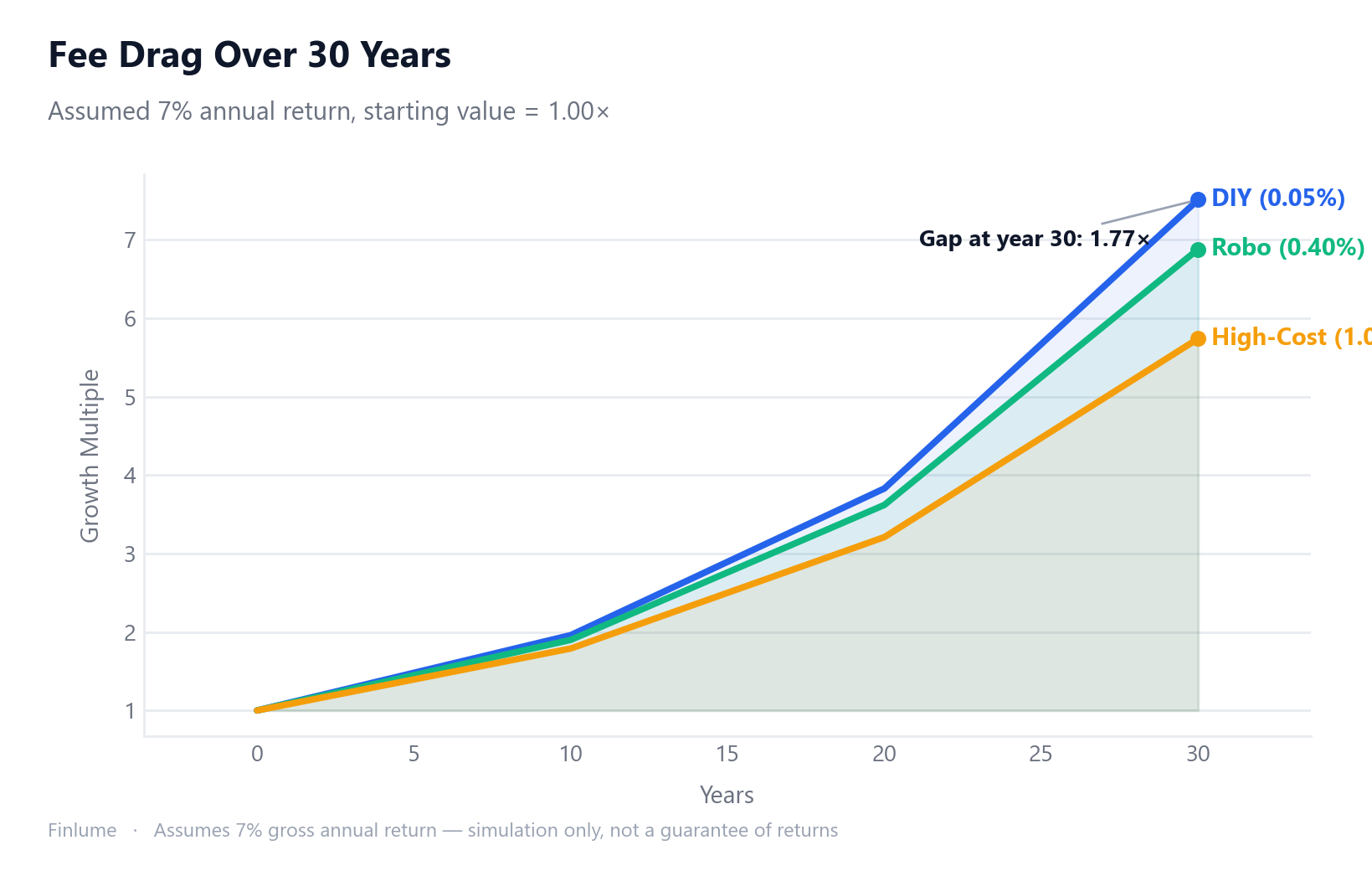
The SEC’s investor education resources illustrate this with compound growth scenarios (their published example: $100,000 at 4% for 20 years, ~$208,000 at 0.25% vs. ~$179,000 at 1.00%). The table below applies the same compounding logic to a longer horizon — a $100,000 starting balance, assumed 7% annual gross return, held for 30 years:
| Annual Fee | 30-Year Terminal Value | Lost vs. 0% Fee Baseline |
|---|---|---|
| 0.00% | ~$761,000 | — |
| 0.25% | ~$710,000 | ~$52,000 (~7%) |
| 1.00% | ~$574,000 | ~$187,000 (~25%) |
These are illustrative projections only. Actual returns will differ. But the direction is reliable: a 0.25-percentage-point fee difference over 30 years compresses your ending wealth by roughly 7%. A 1.00-percentage-point gap costs you about a quarter of your final balance.
Translating this to the robo vs. DIY comparison: the realistic all-in cost spread is about 0.20–0.50 percentage points per year. Over 30 years, that’s meaningful — but it’s not the whole story.
| Item | Robo-Advisor | DIY Investing |
|---|---|---|
| Management fee (annual) | 0.20–0.50% | None |
| Underlying ETF expense ratio | 0.05–0.20% | 0.03–0.20% |
| All-in estimated cost | 0.30–0.60% | 0.03–0.20% |
| Effective difference | — | ~0.20–0.50%p cheaper |
| Time investment | Minimal | ~1–2 hrs/month |
| Behavioral protection | Structural | Self-managed |
| Customization | Limited | Full |
For a deeper look at how fees erode compounding, see ETF Expense Ratio Long-Term Impact.
The Behavior Gap: The Cost That Dwarfs Management Fees
Most fee comparison articles stop at the table above. That’s the mistake.
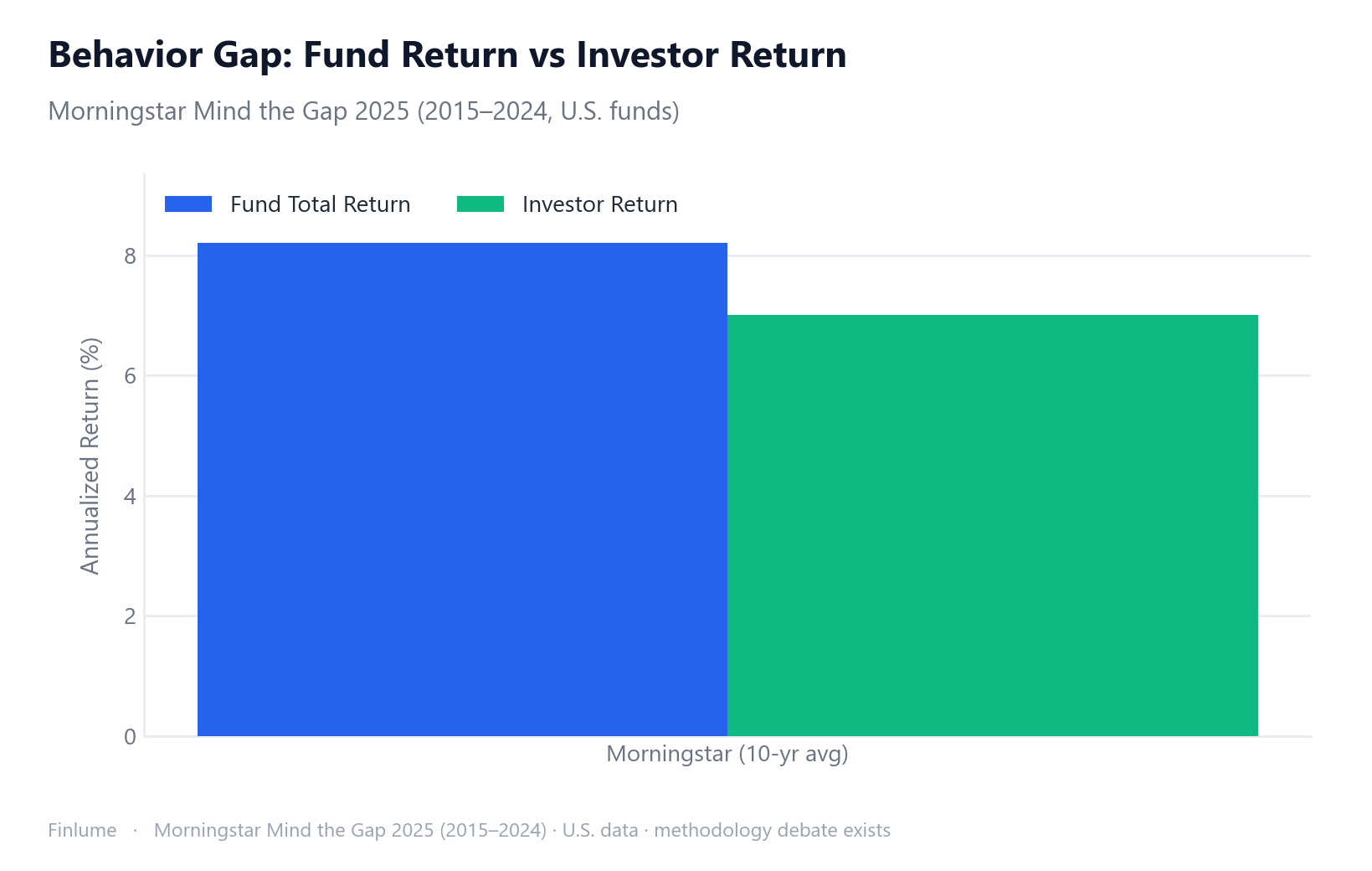
The behavior gap — the difference between a fund’s reported return and what its investors actually realized — is the largest hidden cost in self-directed investing. It isn’t captured in any fee table. It shows up only in data collected after the fact.
Three data points, all pointing the same direction. Note that this gap exists regardless of whether you hold active or index funds — for the evidence on how actively managed funds compare to index funds over time, see Index Fund vs Active Fund Performance.
- Morningstar Mind the Gap 2025: Over the decade from 2015 to 2024, U.S. fund investors realized an average return of 7.0% per year versus their funds’ 8.2% total return — a gap of 1.2 percentage points annually. The cause: investors moved money in and out at the wrong times.
- DALBAR 2025 (single-year snapshot): In 2024, the average U.S. equity fund investor earned 16.54% while the S&P 500 returned 25.02% — a single-year gap of 8.48 percentage points. Note: DALBAR’s methodology has been questioned in academic literature (see SSRN discussion), and single-year figures are more volatile than decade averages. The directional finding — investors consistently underperform the funds they hold — is widely accepted across methodologies.
- Vanguard research (2000–2012): A comparable analysis estimated the average investor-versus-fund gap at roughly 1.55 percentage points per year over that period.
The implication is stark. If your behavioral shortfall runs 1.2 percentage points per year — which is the Morningstar decade estimate — that alone exceeds the management fee difference between a robo-advisor and DIY. You can’t model this cost in a spreadsheet, but it’s more real than any expense ratio.
Behavioral biases aren’t a uniquely American problem. The mechanism — buying high, selling low, chasing performance — plays out in every market. The robo-advisor’s structural value isn’t its fee; it’s the circuit breaker it installs between your panic and your portfolio.
5 Questions That Actually Decide It
Stop optimizing for fees until you’ve answered these five questions. The answers will tell you more than any cost comparison.
| # | Question | DIY-favorable | Robo-favorable |
|---|---|---|---|
| Q1 | How large is your portfolio? | Larger balances: fee savings in absolute dollars grow, making DIY’s 0.20–0.50%p advantage matter more | Smaller balances: the absolute fee difference is minor; automation’s convenience outweighs it |
| Q2 | Can you commit 1–2 hours per month to this? | Yes, reliably | No, or not consistently |
| Q3 | Do you understand diversification, rebalancing, and expense ratios well enough to act on them? | Yes | No — automation prevents costly missteps |
| Q4 | Have you ever panic-sold during a market downturn? | No, and you have evidence you can hold | Yes, or you’re genuinely unsure |
| Q5 | Do you need customization that a standard portfolio can’t provide? | Yes — this is the clearest case for DIY | No — standard allocation is fine |
Q4 is the one that trips people up. If you’ve panic-sold before, the lower fees of DIY investing may not survive your first bear market. Before answering, it helps to do a proper risk tolerance self-assessment — not just a gut feeling, but an honest look at your history with money under stress.
Can You Graduate from Robo to DIY — or Run Both?
The robo-vs-DIY choice doesn’t have to be permanent or binary.
Gradual transition. Start with a robo-advisor, build your knowledge while markets do what they do, and when your portfolio reaches a size where the fee difference becomes material in dollar terms, shift to direct ETF management. Many investors make this transition somewhere around a meaningful threshold — when the annual fee savings justify the time investment.
Core-satellite hybrid. Keep 70–80% in a robo-managed portfolio for stability and automation, and run 20–30% as a direct ETF sleeve to express a specific tilt or view. This captures automation’s behavioral benefit for the bulk of your wealth while allowing genuine customization at the edges.
One thing to watch: frequent switching generates costs. Every time you move between approaches, you may face trading costs and — depending on your tax situation — potential gain realization. The goal is a structure you’ll stay in for years, not one you’ll keep reconsidering.
The deeper point: optimizing your investment method is the second-order problem. Staying invested consistently — through bear markets, through boring flat years, through life distractions — is the first-order problem. A robo-advisor that keeps you invested through a 30% drawdown beats a DIY approach you abandon at the worst moment, every single time.
The Real Decision: How Much Behavior Gap Can You Afford?
The fee-versus-behavior-gap tradeoff has a precise crossover point that most comparisons never calculate. Here it is.
Assumptions (illustrative — actual returns will differ): 7% gross annual return; robo-advisor all-in cost 0.40%/yr; DIY all-in cost 0.10%/yr; behavior gap applied to DIY only (robo’s structural automation is assumed to eliminate timing mistakes).
| Scenario | 10 yr | 20 yr | 30 yr |
|---|---|---|---|
| Robo-advisor (0.40% fee, ~0% behavior gap) | 1.89× | 3.59× | 6.80× |
| DIY — disciplined (0.10% fee, 0% gap) | 1.95× | 3.80× | 7.40× |
| DIY — moderate (0.10% fee, 0.6pp gap) | 1.84× | 3.39× | 6.25× |
| DIY — typical (0.10% fee, 1.2pp gap) | 1.74× | 3.03× | 5.28× |
Growth multiples from a starting value of 1.0. Computed via compound interest arithmetic; not a forecast.
The break-even is sharper than most people expect: a behavior gap of just 0.30 percentage points per year is enough to erase DIY’s entire fee advantage over 30 years. That’s the fee-saving threshold — anything above it and the robo-advisor produces a better net outcome despite costing more.
Morningstar’s decade-average gap (1.2pp/yr) is four times that threshold. A DIY investor running the typical investor behavior gap ends up with a 30-year multiple of 5.28× — roughly 22% below the robo outcome of 6.80×, even though the robo paid four times more in annual fees. The fee advantage is real, but it’s fragile: it requires near-perfect behavioral discipline to survive 30 years intact.
The disciplined DIY scenario (0% gap) does outperform: +0.60× over 30 years, which is genuine and worth having if you can maintain it. The question the table forces you to answer honestly is: which row are you actually in?
- I’ve read the break-even table and identified which scenario realistically describes my behavioral track record
Key Takeaways
- I’ve examined how I actually behave during market downturns — not how I think I’d behave
- I’ve run through all 5 questions: portfolio size, time availability, knowledge level, behavioral history, customization needs
- I know the all-in cost range: robo-advisors 0.30–0.60%/yr, DIY 0.03–0.20%/yr
- I understand the behavior gap (1.2%p/yr, Morningstar 2025) and know it can exceed the fee difference
- I’ve considered that gradual transition and core-satellite hybrids are real options
- I’ve accepted that consistent investing beats method optimization
The right choice is the one you’ll actually stick with. Answer the five questions honestly, and the answer is usually clear.
Frequently Asked Questions
Q. What is a robo-advisor and how does it work?
A robo-advisor is an algorithm-driven automated investment service. It assesses your risk tolerance and goals, then builds and manages a diversified portfolio of stock and bond ETFs on your behalf. When allocations drift beyond a target threshold, the system automatically rebalances. Many services also automate regular contributions (dollar-cost averaging) and apply tax-efficiency algorithms. The median management fee is around 0.25% per year, with a typical range of 0.20–0.50% (Morningstar 2024).
Q. Is a robo-advisor more expensive than DIY investing?
On management fees alone, yes — robo-advisors add roughly 0.20–0.50 percentage points that DIY investors don’t pay, since DIY investors typically pay only ETF expense ratios of 0.03–0.20%. But once you factor in the behavior gap, the calculation shifts. According to Morningstar’s 2025 Mind the Gap report, U.S. fund investors realized returns averaging 1.2 percentage points per year below their funds’ total returns over 2015–2024. The cost of emotional decision-making can dwarf the management fee gap.
Q. What is the behavior gap?
The behavior gap is the difference between what a fund actually returned and what its investors actually realized — caused by mistimed trades: panic-selling during downturns, piling in after a run-up. Morningstar’s 2025 Mind the Gap report measured this at 1.2 percentage points per year on average over 2015–2024 for U.S. fund investors. Compounded over decades, this shortfall far exceeds the cost difference between a robo-advisor and a DIY approach.
Q. Is a robo-advisor better for beginners, or should they go DIY?
Automation tends to offer more advantages for beginners: diversification and rebalancing happen without prior knowledge, and the structure prevents emotion-driven decisions during market drops. That said, this isn’t a blanket recommendation. Run through the 5 questions in this article — investment size, available time, knowledge level, history of panic-selling, and customization needs — and let your answers guide you.
Q. Can I switch from a robo-advisor to DIY investing later?
Yes. Many investors start with a robo-advisor, build capital and knowledge, then transition to managing their own ETF portfolio. A gradual shift or a core-satellite hybrid (robo for the bulk, DIY for a satellite portion) are both viable. Watch out for frequent switching, though — each transition can generate trading costs and unexpected tax events.