The Rule of 72 Explained: How to Calculate Doubling Time in Your Head — and When Not To
Someone asks you at a dinner table: “If I invest at 8% a year, how long until my money doubles?” You don’t reach for your phone. You say “nine years” before they’ve finished the sentence. That’s the Rule of 72 — divide 72 by your annual rate and you have your answer. The precise calculation gives 9.006 years. Error: under 0.1%.
Here’s the bottom line up front: N ≈ 72 / r, where N is years to double and r is your annual rate as a whole number. The Italian mathematician Luca Pacioli first noted this relationship in his 1494 work Summa de Arithmetica, and investors have been using it ever since — five centuries of mental math with no calculator required. But knowing the trick is one thing; understanding why it works, where it holds, and where it quietly misleads you is what separates a useful tool from a dangerous shortcut.
What the Rule Actually Says — The Formula and the Divisor Choice
The rule is one line:
Years to double ≈ 72 ÷ annual rate (%)
A few quick examples:
| Annual rate | 72 ÷ r | What it means |
|---|---|---|
| 6% | 12 years | $10,000 → $20,000 |
| 8% | 9 years | $10,000 → $20,000 |
| 10% | 7.2 years | $10,000 → $20,000 |
| 12% | 6 years | $10,000 → $20,000 |
Why 72 specifically? One practical reason: 72 has more useful divisors than nearby numbers. Its divisors include 1, 2, 3, 4, 6, 8, 9, and 12 — every common round rate you’re likely to encounter divides neatly into 72. Try using 70 for a 6% rate and you get 11.67 years, which is harder to work with in your head. The math chose 72 not because it’s theoretically optimal, but because it’s operationally clean. That distinction matters.
Why 69.3 Isn’t the Number — The Math Behind the Choice
The mathematically precise answer comes from solving the compound interest equation:
(1 + r)^N = 2
Take the natural log of both sides:
N = ln(2) / ln(1 + r) ≈ 0.693 / r
Since ln(2) ≈ 0.693, the theoretically correct constant is 69.3. But here’s where it gets interesting: in real annual compounding, ln(1 + r) is slightly smaller than r. At r = 0.08, for instance, ln(1.08) = 0.07696, a hair below 0.08. That gap means the denominator in practice is smaller than the theory assumes, which means you should push the numerator up slightly above 69.3 to compensate. The sweet spot for annual compounding in the common investment range lands around 72 — and it also happens to be easy to divide. Both factors contributed to the convention.
Verify it at 8%: the exact answer is ln(2)/ln(1.08) = 9.006 years. The Rule of 72 gives 9.0 years. A rounding error smaller than most people’s measurement noise.
When you need more precision without a spreadsheet, the SEC’s investor education resource Investor.gov covers the Rule of 72 and compound interest, and the adjusted formula is:
t ≈ 69/r + 0.35 (r as a percentage)
Plug in 8%: 69/8 + 0.35 = 8.625 + 0.35 = 8.975 years. Actual: 9.006. The improvement is real, but the calculation is harder to do in your head. Classic trade-off between accuracy and usability.
Where the Rule Stays Accurate — and Where It Falls Apart
All figures below assume fixed annual compounding, before taxes.
| Annual rate | Rule of 72 (years) | Exact (years) | Error |
|---|---|---|---|
| 2% | 36.0 | 35.0 | +2.9% |
| 4% | 18.0 | 17.67 | +1.9% |
| 6% | 12.0 | 11.90 | +0.8% |
| 8% | 9.0 | 9.01 | -0.1% (sweet spot) |
| 10% | 7.2 | 7.27 | -1.0% |
| 12% | 6.0 | 6.12 | -1.9% |
| 15% | 4.8 | 4.96 | -3.2% |
| 20% | 3.6 | 3.80 | -5.3% |
| 25% | 2.88 | 3.11 | -7.4% |
| 50% | 1.44 | 1.71 | -15.8% |
The 6–10% band keeps errors under 1%, more than adequate for everyday investment planning. Once you cross 15%, accuracy deteriorates noticeably. Above 20%, the rule consistently understates the true doubling time — meaning real life takes longer than the shortcut suggests. At 50%, the understatement is nearly 16%. That’s not a rounding error; that’s a different story entirely.
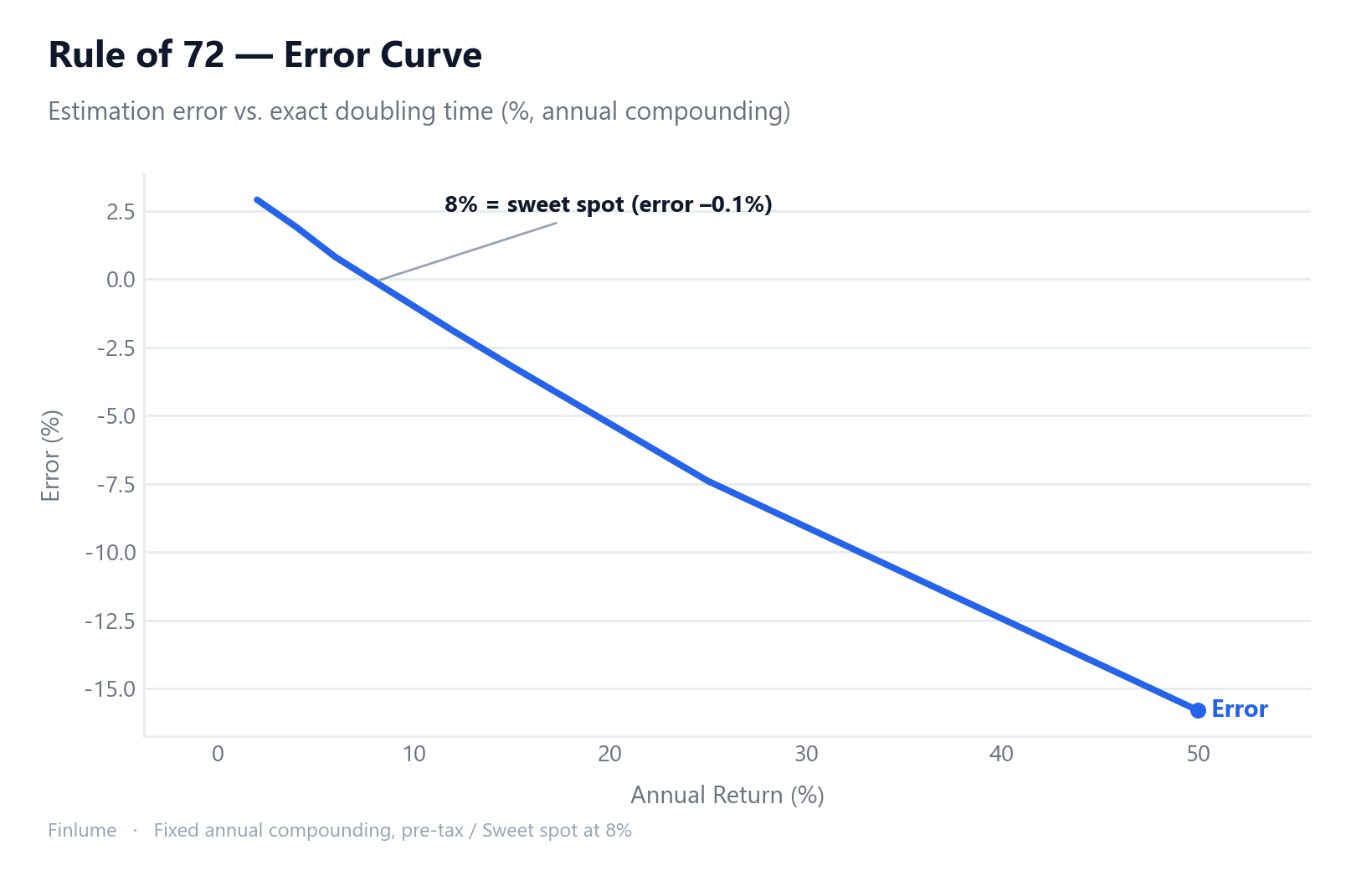
I’ve seen people apply this rule to high-yield scenarios and come away overconfident. The table above is worth keeping somewhere visible.
Choosing Between 69, 70, and 72
The right divisor depends on your compounding setup:
| Situation | Use this | Reason |
|---|---|---|
| Annual compounding, 6–10% (typical investing) | 72 | Divisor-rich, lowest error in this range |
| Low rates — 1–4% (savings accounts, bonds) | 70–71 | Corrects the upward bias at low rates |
| Continuous compounding (theoretical) | 69.3 | Derived directly from ln(2) |
| Daily compounding (money market funds) | 69 | Approximates continuous compounding |
| Highest practical precision, no calculator | t ≈ 69/r + 0.35 | Best approximation across a wide range |
A useful rule of thumb: for every 3 percentage points you move away from 8%, shift your divisor by roughly 1. Moving well above 8%? Nudge toward 70 or below. Staying near 8%? 72 is fine. It’s not rigid — it’s calibration.
Beyond Investing — Inflation, Fees, and Debt
This is where the Rule of 72 earns its keep beyond portfolio math. Any quantity that grows or shrinks at a constant rate follows the same logic.
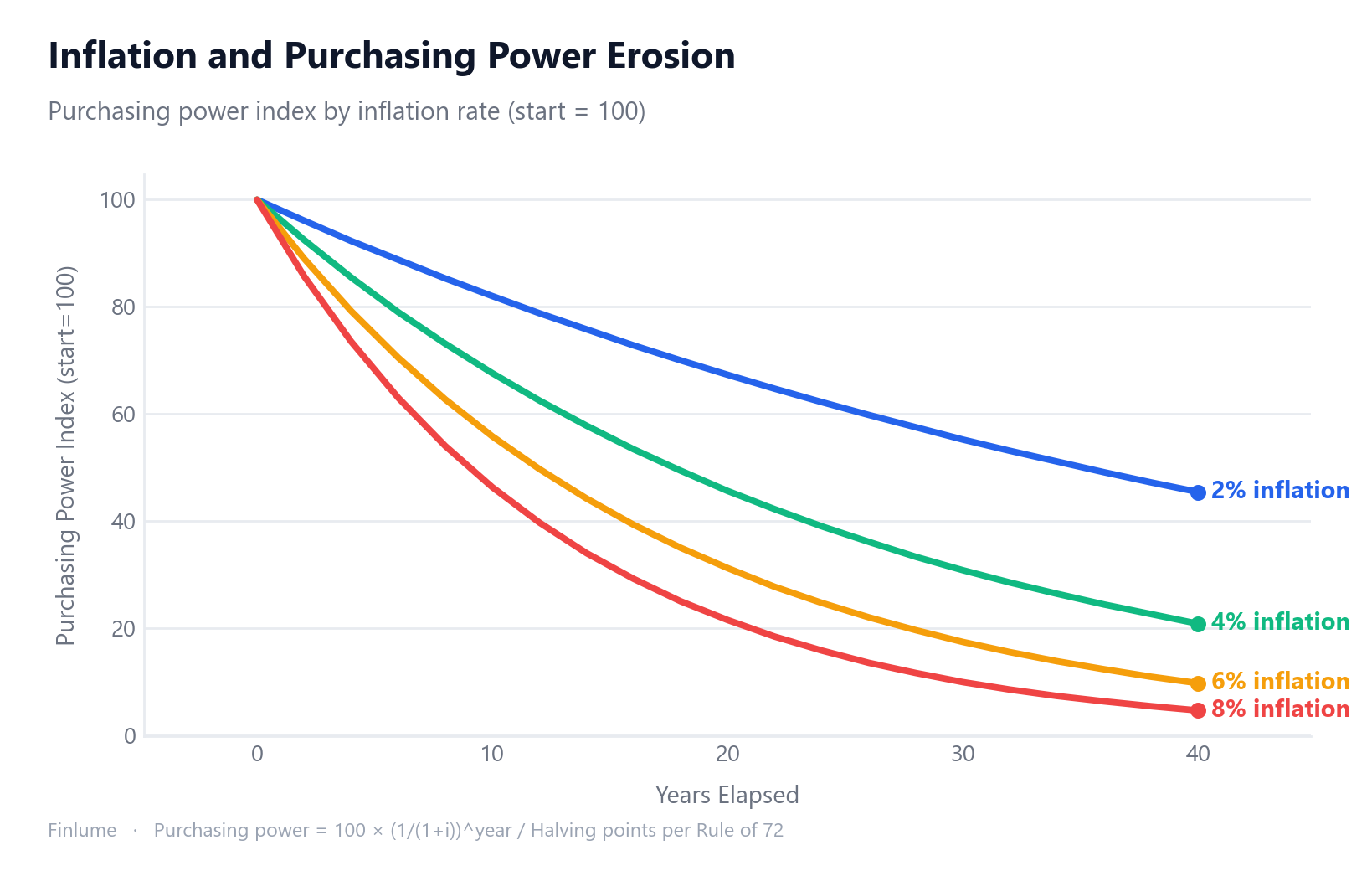
Inflation: when does your purchasing power get cut in half?
Plug the inflation rate into r:
| Inflation rate | Purchasing power halved in |
|---|---|
| 2% | 36 years |
| 3% | 24 years |
| 4% | 18 years |
| 6% | 12 years |
| 8% | 9 years |
I’ve run this for people who say they’re “happy keeping cash.” At 3% inflation, that stack of $10,000 buys the same things as $5,000 does today — 24 years from now. That’s not abstract. That’s a retirement savings plan undermined by inertia.
Fee drag: how much does 1% cost over 30 years?
At a nominal 8% return, change only the annual fee. The full mechanics of how fees compound against you are covered in Why a 1% Fee Quietly Costs You Half Your Retirement.
| Fee | Net return | Years to double |
|---|---|---|
| 0% | 8% | 9.0 years |
| 1% | 7% | 10.3 years |
| 2% | 6% | 12.0 years |
A 3-year difference in doubling time doesn’t sound catastrophic. But over a 30-year horizon, a 1 percentage point fee difference translates to roughly a 20–25% reduction in final wealth. Starting with $10,000, that’s the difference between roughly $76,000 and around $57,000. Same market, same starting amount, just a different fee. I’m not making a dramatic point here — I’m just showing you what the math says.
Real vs. nominal return: the number that matters
Nominal 7% minus 3% inflation equals a real return of 4%. Using the Rule of 72: doubling time rises to 18 years. Using the nominal 7%, you’d estimate 10.3 years. That’s a 7.7-year gap in your planning assumptions. If you’re building toward a specific goal, run the real rate through the compound interest calculator and check whether the timeline still works.
Debt: the same math, running against you
Not all debt behaves the same way — the difference between good and bad debt is worth understanding before you run these numbers. At 20% credit card interest: 72 ÷ 20 = 3.6 years for the balance to double. The exact figure is 3.80 years (error: -5.3%). At 25%: 72 ÷ 25 = 2.88 years; exact is 3.11 years (error: -7.4%). At high rates, the rule underestimates the true doubling time — meaning the shortcut predicts a faster doubling than actually occurs. In practice, debt at 20% takes 3.80 years to double, not the 3.6 years the rule implies. The shortcut is actually overstating the danger slightly, but that’s no reason for comfort: 3.80 years is still alarmingly fast. For high-rate debt, skip the mental math and use an actual calculator.
What the Rule Won’t Tell You: Real After-Cost Doubling Time
Every headline example for the Rule of 72 starts with a nominal rate — “8% for 9 years.” That number is correct but incomplete. It ignores two guaranteed headwinds: annual fees and inflation. When you fold both in, the real, after-cost doubling time is often double the figure you started with.
The table below is computed using the exact formula — years = ln(2) / ln(1 + real net return), where real net return = (1 + nominal rate) / (1 + inflation) × (1 − fee) − 1. All inputs are stated assumptions, not predictions.
Years to double in real purchasing-power terms (exact formula, annual compounding)
| Annual fee | 6% nominal / 2% infl | 8% nominal / 2% infl | 10% nominal / 2% infl |
|---|---|---|---|
| 0.0% | 18.0 yrs | 12.1 yrs | 9.2 yrs |
| 0.5% | 20.7 yrs | 13.3 yrs | 9.8 yrs |
| 1.0% | 24.4 yrs | 14.7 yrs | 10.6 yrs |
| 2.0% | 38.0 yrs | 18.8 yrs | 12.5 yrs |
| Annual fee | 6% nominal / 3% infl | 8% nominal / 3% infl | 10% nominal / 3% infl |
|---|---|---|---|
| 0.0% | 24.1 yrs | 14.6 yrs | 10.5 yrs |
| 0.5% | 29.2 yrs | 16.4 yrs | 11.4 yrs |
| 1.0% | 37.1 yrs | 18.6 yrs | 12.4 yrs |
| 2.0% | 81.5 yrs | 25.5 yrs | 15.2 yrs |
Assumptions: fixed annual compounding, fee deducted from return each year, pre-tax.
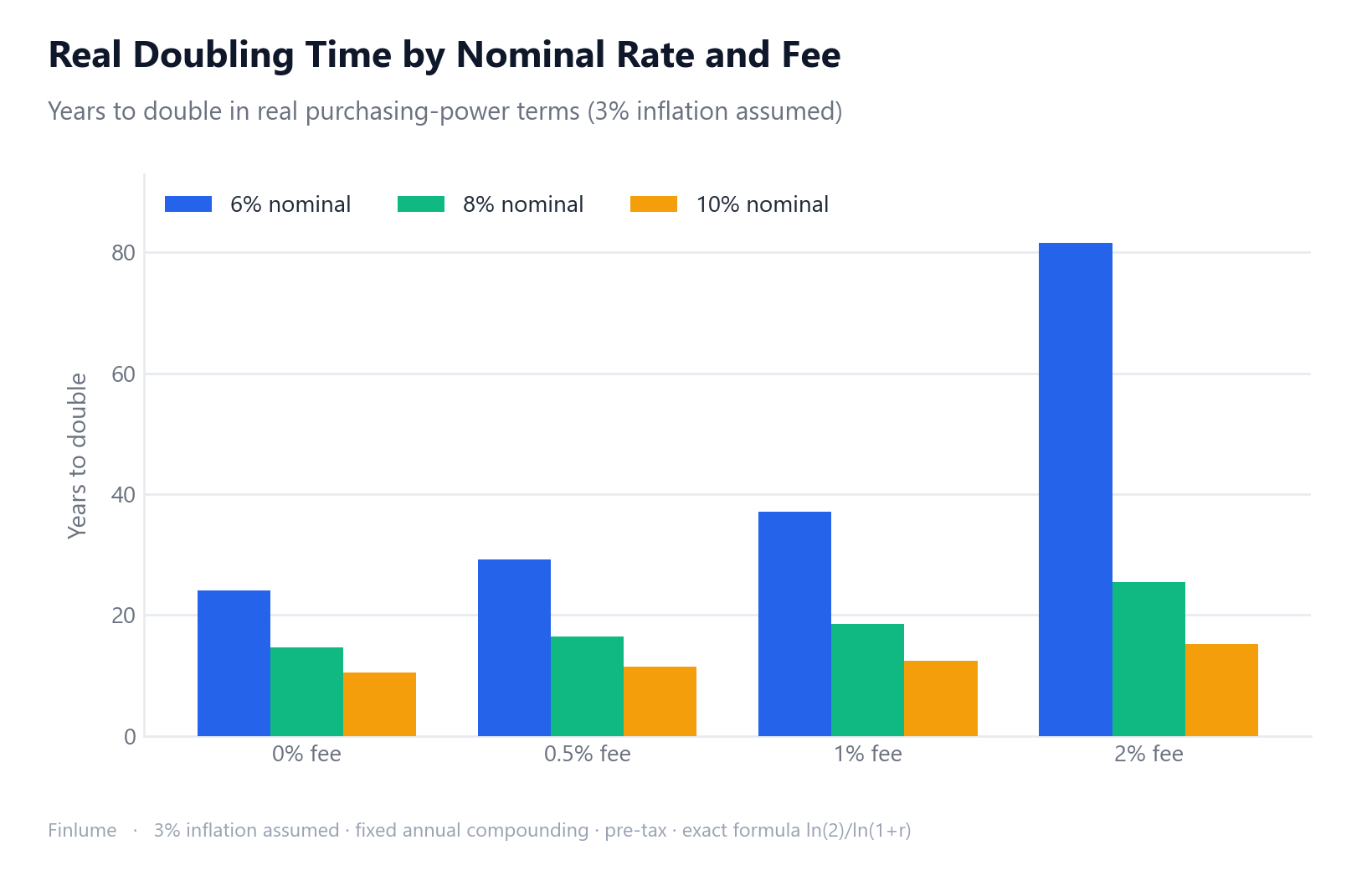
Three things stand out. First, at 6% nominal with a 1% fund fee and 3% inflation, the real doubling time is 37.1 years — not the 12 years the headline rule implies. Second, the 8% case most people use as the benchmark becomes 18.6 years after a 1% fee and 3% inflation, not 9 years. Third, the 2% fee row at 6% nominal / 3% inflation produces a result so long (81.5 years) it is no longer a useful investment scenario — the math is telling you that fees have nearly consumed the real return.
The Rule of 72 gives you the nominal, pre-fee, pre-inflation answer. Use this table as a quick cross-check: find your approximate nominal rate and fee column, pick your inflation assumption, and read the real doubling time directly. If that number no longer fits your planning horizon, adjust the inputs — not the goal.
When the Rule of 72 Fails You
The rule has clear limits. Understanding why compound interest works the way it does makes these limits easier to internalize. Use it anyway in these situations and it becomes misleading:
Variable rates and returns: The rule assumes a fixed, unchanging rate. Equity markets don’t offer that. A stock portfolio averaging 8% per year over two decades doesn’t double every 9 years like clockwork — sequence of returns matters, and volatility alone tends to push actual doubling time beyond what the average rate implies.
Regular contributions: If you’re adding money every month, the Rule of 72 describes how long it takes for your starting balance to double, not your total account balance. Those are different questions. For dollar-cost averaging scenarios, the compound interest calculator gives you a real simulation.
Rates above 20%: As the accuracy table shows, errors climb steeply in this range. The rule systematically understates the true doubling time — meaning your debt or high-growth estimate is more optimistic than reality.
Continuous compounding products: Money market funds and some fixed instruments compound continuously or daily. In those cases, 69 or 69.3 is the right constant, not 72.
And the most important reminder: the Rule of 72 tells you the doubling time, not that doubling will happen. It describes what occurs if your rate holds constant for the full period — a condition that’s never guaranteed. Treat it as a planning tool for orientation, not a forecast.
Key Takeaways
- The formula: Years to double ≈ 72 ÷ annual rate (%). At 6%: 12 years. At 8%: 9 years. At 10%: 7.2 years.
- Why 72: Abundant divisors (1, 2, 3, 4, 6, 8, 9, 12) for clean mental math, plus it corrects for the gap between ln(1+r) and r in annual compounding. Better than 69.3 for typical investment rates.
- Precision upgrade: t ≈ 69/r + 0.35 when you need more accuracy without a calculator.
- Sweet spot: 6–10%. Error under 1%. Above 15%, accuracy declines sharply; above 20%, the rule consistently underestimates how long doubling actually takes.
- Inflation: 3% inflation halves purchasing power in 24 years. 6% does it in 12.
- Fees: A 1% annual fee difference shifts your doubling point by 1.3 years and costs roughly 20–25% of final wealth over 30 years.
- Debt: At 20% interest, balance doubles in 3.80 years (not the 3.6 the rule suggests). High-rate debt is worse than the shortcut implies.
- Real after-cost view: At 8% nominal with a 1% fee and 3% inflation, real doubling time is 18.6 years — not 9. At 6% with the same cost and inflation drag, it stretches to 37.1 years. Always apply the rule to your real net rate, not the headline number.
- Don’t use it for: Variable returns, ongoing contributions, rates above 20%, or continuous-compounding products.
- The bottom line: A directional tool, not a guarantee. Valid only under fixed-rate, pre-tax, lump-sum assumptions.
The Rule of 72 won’t replace a proper calculator for serious planning. But for a quick reality check — how long before this investment doubles, how fast this debt spirals, how soon inflation erodes this savings balance — it’s one of the most efficient mental tools in personal finance. Use it for direction. Verify with numbers when the decision is real.
Frequently Asked Questions
Q. Why use 72 instead of the mathematically exact 69.3?
The theoretically precise constant is 69.3, derived from ln(2) ≈ 0.693. But in real annual compounding, ln(1+r) is slightly smaller than r, which means the numerator needs to be pushed up above 69.3 to compensate. That correction lands near 72, and 72 also has abundant divisors (1, 2, 3, 4, 6, 8, 9, 12) that make mental math clean. In the 6–10% range, 72 is actually more accurate than 69.3 for annual compounding.
Q. Can I trust the Rule of 72 for high-interest debt at 20–25% or above?
At high rates, the rule underestimates the true doubling time — meaning the rule predicts a faster doubling than actually occurs. At 20%, the error is -5.3% (rule says 3.6 years; actual is 3.80 years). At 25%, the error reaches -7.4% (rule: 2.88 years; actual: 3.11 years). At 50%, it hits -15.8%. In a debt context, the shortcut actually overstates the threat slightly — real debt doubles a bit later than the rule suggests. Either way, verify with the exact formula ln(2)/ln(1+r) or a calculator for any high-rate debt decision.
Q. Does the Rule of 72 work for monthly compounding?
Monthly compounding is close to continuous compounding, so 69 or 69.3 is a more accurate constant than 72. Using 72 for monthly-compounding products slightly overestimates the doubling time. For money market funds and daily-compounding instruments, 69 is the standard choice.
Q. Can I apply the Rule of 72 to credit card debt or loans?
Yes, the same logic runs in reverse. At 20% credit card interest, 72 divided by 20 gives 3.6 years for the balance to double. The exact figure is 3.80 years — meaning the rule actually paints a slightly scarier picture than reality at high rates (it predicts faster doubling than actually occurs). It works as a quick gut-check, but always run the real numbers for high-rate debt. If you’re deciding which debts to pay off first, the debt snowball vs. avalanche comparison is a practical next step.
Q. How long does inflation take to cut purchasing power in half?
Use 72 divided by the inflation rate. At 4% inflation, purchasing power halves in 18 years. At 2%, it takes 36 years. At 6%, 12 years. At 8%, just 9 years. Even at a modest 3% inflation rate, a $10,000 cash balance loses half its real purchasing power within 24 years. For the full picture on how inflation quietly erodes savings, that’s the deeper read.