How to Shift Your Stock-Bond Mix as You Age: The Glide Path Guide
If a 30-year-old and a 60-year-old are holding the same stock-to-bond ratio, one of them has it wrong. Which one depends on the specifics—but there’s no good reason their allocations should look identical.
When most people learn to invest, nobody teaches them “when do you start buying bonds?” You learn about compound interest, diversification, index funds. Then a decade or two in, the question that keeps nagging you is: “Is the ratio I’m holding actually right for my age?”
This guide answers that question. We’ll cover the principle (why age matters for allocation), the numbers (how much to shift), and the execution (how to do it).
The term “glide path” comes from aviation. It’s the angle at which a plane descends toward the runway. A portfolio works the same way: as you approach the runway of retirement, you gradually reduce your altitude of risk. That’s the essence of the glide path strategy. If asset allocation is new to you, our guide to asset allocation basics covers the foundations before we go further here.
What a Glide Path Actually Is
A glide path is a curve that progressively adjusts the ratio of stocks (higher risk) to bonds (lower risk) in your portfolio over time. The key word is gradually—not a sudden switch, but a slow directional shift year by year. Corporate Finance Institute defines it as “a structure for managing risk exposure over time in line with an investor’s life goals.”
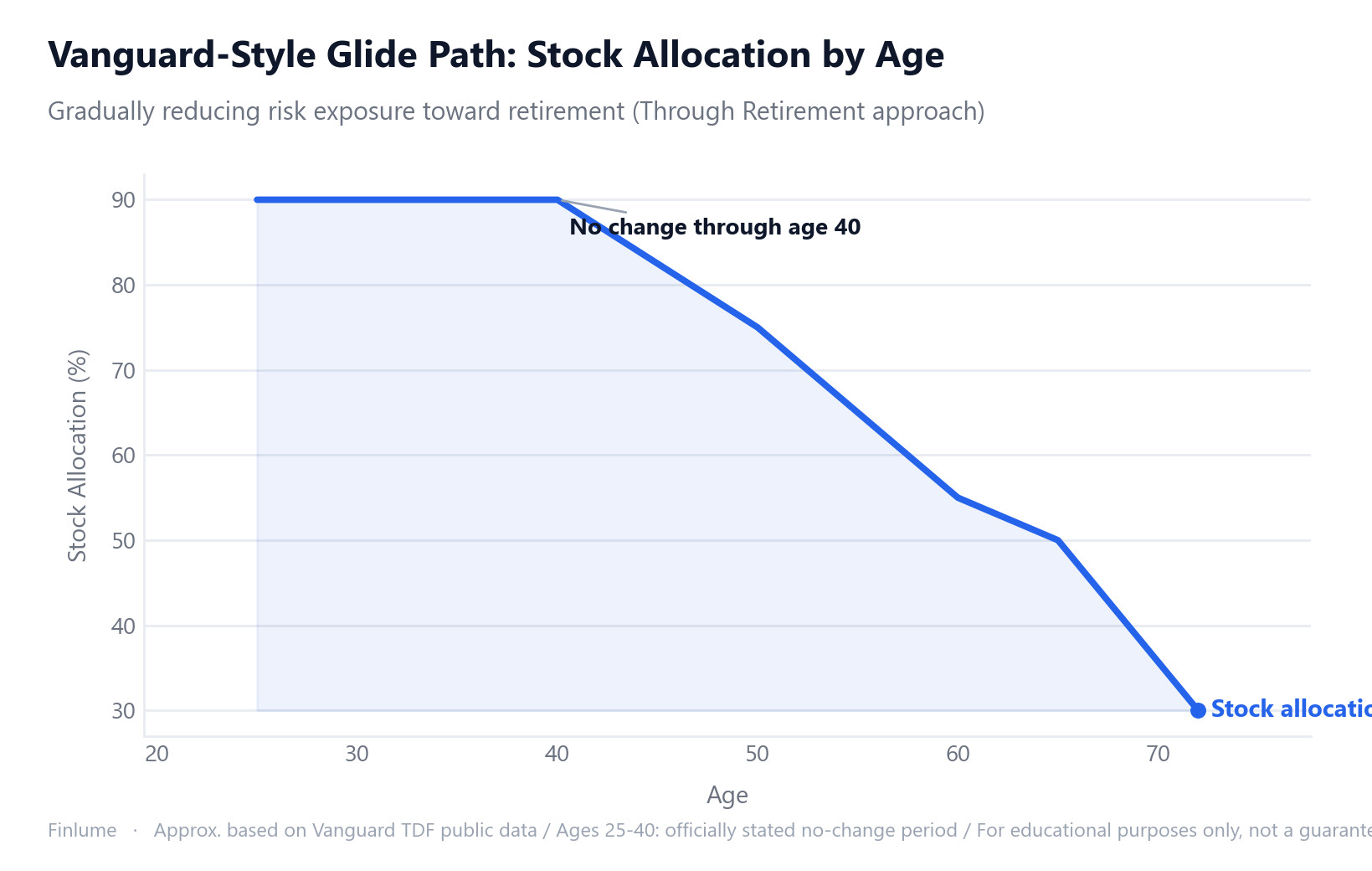
Vanguard’s target-date funds (TDFs) give us a concrete reference point for what this looks like in practice:
| Age | Stock Allocation (approximate) |
|---|---|
| 25 | 90% |
| 40 | 90% |
| 50 | ~75% |
| 55 | ~65% |
| 60 | ~55% |
| 65 (retirement) | ~50% |
| 72 | ~30% |
Note: The 25–40 age range reflects Vanguard’s stated “no change” period. Values for subsequent age bands are approximations based on publicly available information.
I’ve seen investors surprised by the fact that stocks stay at 90% all the way through age 40. That’s a surprisingly long aggressive phase. The reason why becomes clear in the next section.
One practical point upfront: the direction matters more than the exact number. Whether you’re at 65% or 68% stocks at age 55 is less important than the fact that you’re lower than you were at 30, and continuing to drift downward.
Why Age Is the Baseline — Human Capital and Time Horizon
Here’s the core insight: when you’re young, your paycheck is already functioning as a “hidden bond” in your portfolio.
According to Merton’s (1971) human capital theory, future labor income resembles a bond in that it provides a relatively stable stream of cash flows. An SSA policy brief summarizes this logic: young investors can hold more stocks in their financial portfolio because their large stock of human capital (future earned income) is already providing bond-like stability to their total wealth.
As you age, the opposite happens. Labor income declines, financial assets grow, and that hidden bond disappears. To maintain the same overall risk balance, you need to start holding actual bonds.
Time horizon reinforces this. A 25-year-old who sees their portfolio cut in half has 40 years to recover. A 65-year-old who faces the same crash may be forced to sell at the worst moment to fund living expenses—before the recovery arrives. With life expectancy in developed countries averaging around 76 years for men and 82 for women (2024 estimates; this varies significantly by region), retiring at 65 means needing assets to last another 25–30 years.
Job stability shifts this calculus further. If your income is highly predictable—think long-term salaried employment—the bond-like quality of your human capital is stronger, and you can reasonably skew your financial portfolio more toward stocks. It’s a logical application of the same principle.
The 100/110/120 Rules — Useful Starting Points, Not Conclusions
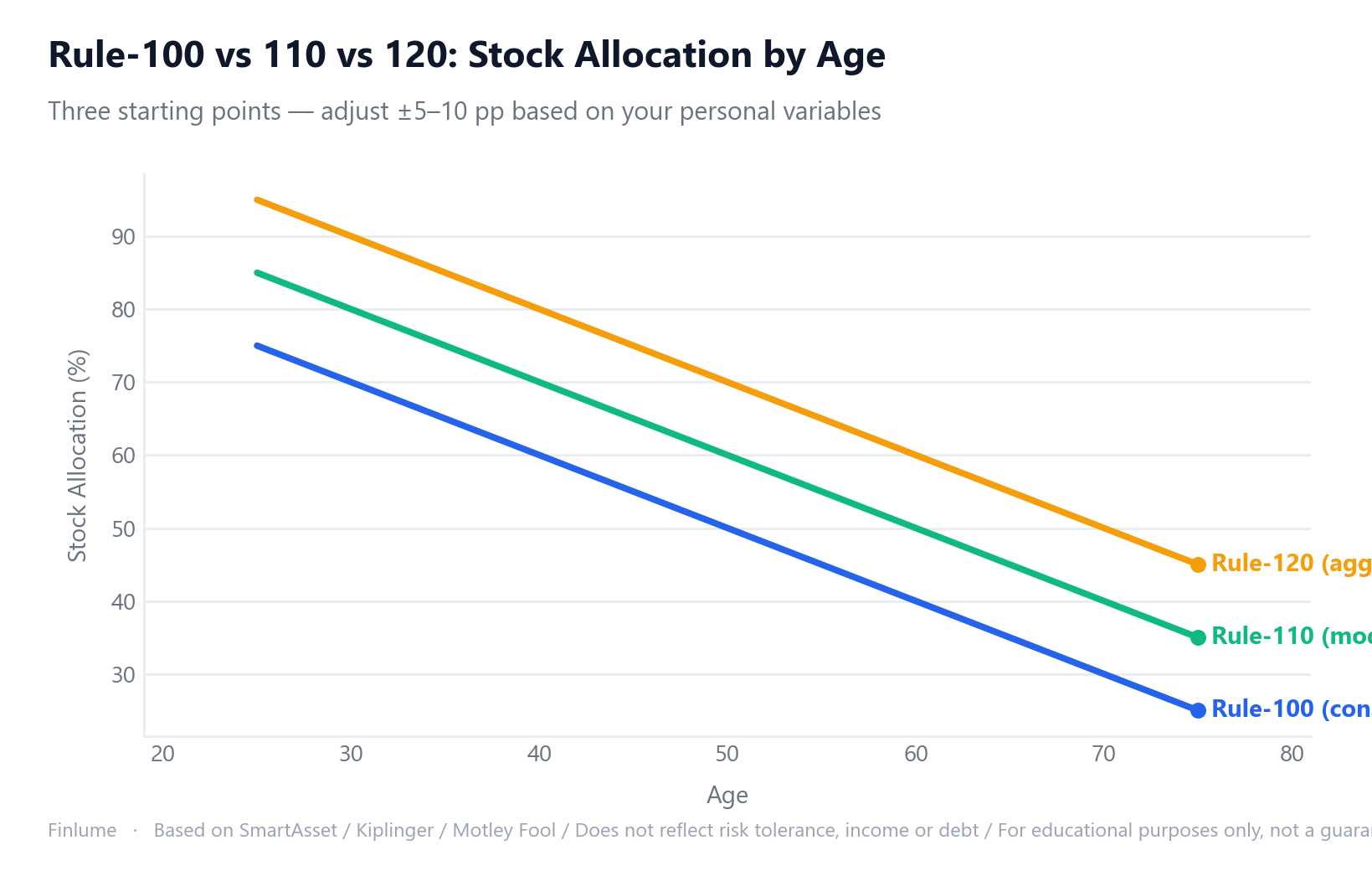
The “subtract your age” rules remain useful as a baseline. But there are three versions, and which one fits you depends on your personal situation.
| Age | Rule-100 (conservative) | Rule-110 (moderate) | Rule-120 (aggressive) |
|---|---|---|---|
| 25 | 75% | 85% | 95% |
| 30 | 70% | 80% | 90% |
| 40 | 60% | 70% | 80% |
| 50 | 50% | 60% | 70% |
| 60 | 40% | 50% | 60% |
| 70 | 30% | 40% | 50% |
| 75 | 25% | 35% | 45% |
The “Rule of 100” was designed in an era when bonds paid decent yields and lifespans were shorter. As life expectancy rose and interest rates fell across developed markets, practitioners started bumping that number to 110, then 120. Vanguard founder John Bogle was among those who advocated for the Rule of 120.
The numbers back up the shift. Looking at U.S. data from 1928–2025 (NYU Stern Damodaran), stocks (S&P 500, including dividends) compounded at roughly 9.8% annually versus about 5.2% for 10-year Treasuries. Relying heavily on bonds to outpace inflation over a 25–30 year retirement window becomes increasingly difficult at those return levels.
A few important caveats: these rules say nothing about your risk tolerance, income stability, debt load, or real assets. Industry sources consistently present them as “starting points,” not final answers. If you’re unsure where to begin, Rule-110 is a reasonable middle ground—then adjust ±5–10 percentage points based on your individual variables.
”To” vs. “Through” — Retirement Isn’t the Finish Line
One of the most overlooked questions when choosing a glide path: do you stop reducing stocks on the day you retire, or do you keep lowering the ratio for years after?
- “To” approach: Stocks reach their minimum target on retirement day and stay there.
- “Through” approach: Stocks continue declining for roughly 7–10 years past retirement.
Vanguard’s TDFs use the “Through” approach. Stocks stand at roughly 50% at retirement age 65, then continue falling to about 30% by age 72. T. Rowe Price is more aggressive—it keeps reducing through age 95 and maintains stock exposure roughly 5 percentage points above the industry average throughout. Fidelity Freedom Funds start at about 51% stocks at retirement and can reach as low as 19%.
If you retire at 65 and live to 90, you have 25 years to manage. Running mostly bonds the entire time means inflation quietly erodes your purchasing power. The “Through” strategy accepts some short-term volatility in exchange for keeping enough growth potential to fund a long retirement. If stable income—pensions, rental income, or similar—covers more than 60% of your living expenses, you can lean toward the “Through” approach with more confidence.
The Most Dangerous Window — Sequence-of-Returns Risk
This is where the stakes get real, and the tone gets serious.
When you take losses matters more than how much you lose. Research by Wade Pfau shows that the returns in the first ten years of retirement determine roughly 77% of the portfolio’s final balance. This is called sequence-of-returns risk (SOR). For a deeper treatment of this concept, our sequence-of-returns risk guide walks through the mechanics and mitigation strategies in detail.
The mechanism is straightforward: once you’re in drawdown mode, you’re selling shares every month to fund expenses. When markets fall, you’re selling at depressed prices. Those sold shares are gone—when the market recovers, you no longer own them. In your working years, time works for you. In retirement, as withdrawals continue, time can work against you.
Pfau and Kitces (2014) produced a counterintuitive finding from this: starting retirement with stocks at just 20–40%, then gradually increasing to 60–80% over the following decades—an “ascending glide path”—reduced both the probability and magnitude of portfolio depletion compared to the traditional descending approach (assuming 4% annual withdrawals). This was based on U.S. historical data, and its applicability to non-U.S. markets has not been broadly validated. Treat it as a conceptual framework worth knowing, not a universal prescription.
Practically speaking: begin consciously reducing your stock allocation in the five years before retirement. Set aside two to three years’ worth of living expenses in bonds or short-term assets before you retire. This buffer means you won’t be forced to sell equities at the worst time just to cover daily costs.
Same Age, Different Allocation — Personalizing the Formula
Age is where you start—not where you end. Depending on your circumstances, you may reasonably shift your stock allocation 10–20 percentage points in either direction from the standard formulas. Figuring out your actual risk tolerance — not just how you feel today, but your financial capacity and genuine need for returns — makes these adjustments much more defensible.
| Variable | Shift stock % higher | Shift stock % lower |
|---|---|---|
| Job stability | Steady long-term employment | Freelance / self-employed |
| Non-investment income | Pension, rental income | Reliant entirely on portfolio withdrawals |
| Debt | None or low-interest | High-interest debt outstanding |
| Dependents | Few or none | Multiple dependents |
| Health / longevity | Good health, family longevity | Health uncertainty |
| Spending flexibility | Can cut expenses if needed | High fixed costs |
The 60/40 portfolio has held up over time. CFA Institute research (2025) shows a 60/40 split delivered roughly 8–9% nominal annual returns from 1928–2022, finishing positive in about 80% of years. Simultaneous drops in both stocks and bonds occurred just four times in 95 years: 1931, 1941, 1969, and 2022. Drawing sweeping conclusions from 2022 alone ignores the full picture.
The message isn’t “abandon the formula.” It’s “use the formula as a baseline, then plug in your own variables and adjust ±10 percentage points.” If your “higher” factors outnumber your “lower” factors by three or more, Rule-120 is a reasonable starting point. If it’s the reverse, start with Rule-100.
How Much Does Your Rule Choice Actually Matter? A Scenario Analysis
The table above shows stock allocations — but what does each rule actually deliver in real purchasing power? The answer depends heavily on how early you start.
The table below shows what a portfolio indexed to 100 grows to by age 65 under each rule, starting from three different ages. Assumptions (illustrative): stocks return 7% per year in real terms, bonds return 2% per year in real terms. Annual rebalancing to the glide path target. No contributions or withdrawals during accumulation. These are simplified arithmetic scenarios, not forecasts.
| Starting age | Rule-100 (conservative) | Rule-110 (moderate) | Rule-120 (aggressive) |
|---|---|---|---|
| Age 30 (35 years) | 4.91× | 5.80× | 6.84× |
| Age 40 (25 years) | 2.93× | 3.31× | 3.72× |
| Age 50 (15 years) | 1.84× | 1.98× | 2.12× |
Assumptions: 7% real annual stock return, 2% real annual bond return. Annual rebalancing. Starting index = 100. For illustration only — not a forecast.
Two findings stand out. First, the gap between the most conservative and most aggressive rule is not marginal: starting at age 30, Rule-120 produces 39% more terminal real value than Rule-100 over 35 years. At age 50 with only 15 years to go, that gap narrows to just 15% — the rules converge because there’s less time for the equity premium to compound. This is why practitioners consistently argue for Rule-110 or Rule-120 over Rule-100 for investors with long time horizons.
Second, the choice of rule matters far less than starting early. An investor who begins at 30 under Rule-100 (4.91×) still significantly outperforms one who begins at 40 under Rule-120 (3.72×). No rule upgrade compensates for a decade of delayed start.
Target-Date Funds — Automating the Glide Path
If the idea of manually adjusting your allocation every few years sounds like too much, target-date funds (TDFs) do the job for you. Pick a single target retirement year and the fund automatically executes the glide path internally.
U.S. investors have access to a wide range of broad-index-based TDFs listed on U.S. exchanges—names like Vanguard Target Retirement, Fidelity Freedom, and T. Rowe Price Retirement Funds are among the most widely used. Each takes a slightly different approach to the glide path: Vanguard lands at about 50% stocks at retirement, T. Rowe Price at about 55%, and Fidelity at about 51%.
When choosing a TDF, confirm whether it’s “To” or “Through”—the stock allocation you’ll hold ten years into retirement varies significantly between providers. That difference matters more than it might seem when you’re 65.
For a deeper look at the rebalancing mechanics behind all of this, the portfolio rebalancing guide covers the process step by step.
Rebalancing — Once a Year Is Enough
Even after you set a glide path, market movements will push your allocation off target. Rebalancing is the act of bringing it back.
Four-step process:
- Record your target allocation (e.g., age 40: 70% stocks, 30% bonds)
- Check your current allocation once a year, or whenever you drift ±5 percentage points
- Sell the over-weighted asset, buy the under-weighted one
- Every five years, step your target allocation one level lower along the glide path
Rebalancing means selling what’s gone up and buying what’s gone down. It feels wrong—which is usually a sign you’re doing it right.
A small optimization: when adding new money to your portfolio, direct it into whichever asset class is under its target. This restores balance without triggering a sale, keeping transaction costs and tax implications to a minimum.
Key Takeaways
□ Glide path = gradually reducing stock exposure over time (not all at once)
□ Why stocks can be high when young: labor income already acts as a "hidden bond"
□ Starting formulas: Rule-100 (conservative) / Rule-110 (moderate) / Rule-120 (aggressive) — use as a baseline only
□ Adjustment triggers: every 5 years, or when target drifts ±5 percentage points
□ The 5 years before and after retirement = peak sequence-of-returns risk. Manage stock exposure carefully in this window
□ "To" vs. "Through": for longevity risk, "Through" typically offers a better buffer
□ Adjust ±10%p for individual variables: job stability, non-investment income, debt, dependents
□ When choosing a TDF: check how different providers' glide paths diverge after retirement
□ Rebalance annually, or direct new contributions to the under-weighted asset class
□ No formula is worth following blindly — understand the principle, then calibrate it to your situation
□ Rule choice gap: Rule-120 yields ~39% more real value than Rule-100 if you start at 30; only ~15% more if you start at 50. Earlier start beats rule upgrade every time
There’s no perfect ratio. But pointing yourself in the right direction and making small adjustments each year — that’s genuinely enough. To put this in context, see how the 4% withdrawal rule works in practice — it connects directly to how long your glide path actually needs to last.
Frequently Asked Questions
Q. What is a glide path in investing?
A glide path is a strategy that gradually shifts your portfolio from a higher stock allocation toward more bonds as you age. Rather than making a sudden switch, the idea is to reduce risk exposure slowly over time — like an aircraft descending toward a runway. The goal is to align your portfolio risk with your shrinking time horizon as retirement approaches.
Q. What is the “100 minus age” rule, and is it still valid?
The 100 minus age rule suggests holding a percentage of stocks equal to 100 minus your age — so 70% at age 30, 40% at age 60. It was designed when bond yields were higher and lifespans shorter. With longer life expectancy and lower bond returns, many practitioners now use 110 or 120 minus age instead. All three versions are best treated as starting points, not fixed prescriptions.
Q. Should I still hold stocks in retirement?
Yes, for most retirees some equity exposure remains important. If you retire at 65 and live to 90, you have 25 years of expenses to fund — long enough for inflation to seriously erode a bond-heavy portfolio. A “through” retirement glide path keeps stocks declining gradually after retirement rather than stopping on day one, preserving some long-term growth potential.
Q. What is the difference between a “to” and “through” retirement glide path?
A “to” glide path reaches its minimum stock allocation on retirement day and holds it there. A “through” glide path continues declining for 7 to 10 years after retirement. Vanguard’s target-date funds use the “through” approach, moving from roughly 50% stocks at age 65 to about 30% by age 72. If longevity risk is a concern and you lack reliable non-portfolio income, “through” generally provides a better buffer.
Q. How often should I rebalance my portfolio?
Once a year is enough for most investors. A common rule of thumb is to rebalance annually or whenever your actual allocation drifts more than 5 percentage points from your target. More frequent rebalancing tends to increase transaction costs without meaningfully improving outcomes. When adding new contributions, directing them to the underweight asset class can restore balance without selling anything.
This article is for educational purposes only and does not constitute investment advice or a recommendation to buy or sell any security. All investment decisions and their outcomes are your own responsibility.